HabsWorld.net --
Reading from the analysts around the league, the majority of them gave the edge to Tampa Bay over Montreal and Buffalo over Montreal. Most betting sites, which rely heavily on statistics, also gave the edge to Tampa Bay and subsequently Buffalo, but by a much smaller margin than analysts seemed to suggest. For this series between Montreal and Carolina, it would be difficult to find any analyst not based in Montreal favouring the Habs. Meanwhile, the betting sites hover around 70% chance of making the final for the Canes.
This matchup is the ultimate “rest vs rust” series with the Habs having played six more games than the Hurricanes – basically an additional series – and having started the second round four days after the Canes started theirs. The Canes haven’t played a game since May 9th, giving them 12 days rest compared to two for the Canadiens. It remains to be seen how much the rust or the rest will play a role. The rest argument can also be extended over the last few years, where Carolina has played deep into May every season while the Habs got long summers yearly. Isn’t this the excuse for the Florida Panthers? The rust may be a factor for a period or two, but beyond that would be underestimating these players’ ability to prepare and adjust. It will be much more important for both teams to adjust to their new opponent quickly, as we saw in Montreal’s first game versus Buffalo, where they seemed emotionally drained from a tough Game 7 against Tampa Bay.
Among other intangibles that could affect either team is the level of pressure. For most fans, the Habs’ Stanley Cup was arguably winning the Atlantic Division. A quick elimination in the third round would probably change nothing as to the level of success this season has been for them. They will be playing with little expectations from the hockey world. This could be a double-edged sword though if the team plays with a sense of having already reached their objective.
For the Hurricanes, this is a much older team with an average age of 29.1 compared to the Habs at 25.8. They are deep into their contending window but their Achilles’ Heel has been the third round. They have lost in the Conference Finals twice in the last three years, both times to the Panthers, having won only one game in those two series. The pressure is high for them to advance to the Stanley Cup Final, especially as they now face an arguably easier opponent. Carolina will be facing themselves and their fears as much as they will be battling the younger Canadiens with nothing more to prove.
Carolina’s back-to-back sweep would suggest a complete domination over their opponents, making them a much superior team for Montreal to contend with. Although their series against the Philadelphia Flyers was in fact lopsided, the Ottawa series wasn’t as easy. Against the Flyers, the Hurricanes had more than 1.5 Expected goals (xG) in the first three matchups. Game 4 was somewhat closer with 1.0 xG more for the Canes. Against Ottawa, the series could have been very different. Although the Hurricanes dominated the first game with 3.3 xG more than the Sens, the second game ended in the second overtime period with a 0.3 xG differential favouring Carolina. The Senators even outshot them 15-13 in both overtime periods. Had this game been won by Ottawa, the series would have probably been quite different. Game 3 was basically even through the first two periods until the Hurricanes scored their second goal a minute and a half after the Sens had tied it 1-1 late in the second. Carolina closed the game in the third and Ottawa was unable to generate any meaningful chances. Game 4 saw the Sens dominate for the entire game with a xG differential reaching 1.5 xG well into the third when the game was tied at one. A power play goal by Logan Stankoven midway in the third to take the lead killed whatever little hope Ottawa still had.
Carolina is undoubtedly a great team and a clear Cup contender in the Eastern Conference but the sweep versus Ottawa could have been a much tighter series than the results indicate. After the Habs series wins versus Tampa Bay and Buffalo, they will undoubtedly be a much more difficult opponent for the Canes compared to Ottawa. A much tighter matchup would not be surprising based on how both teams have competed so far.
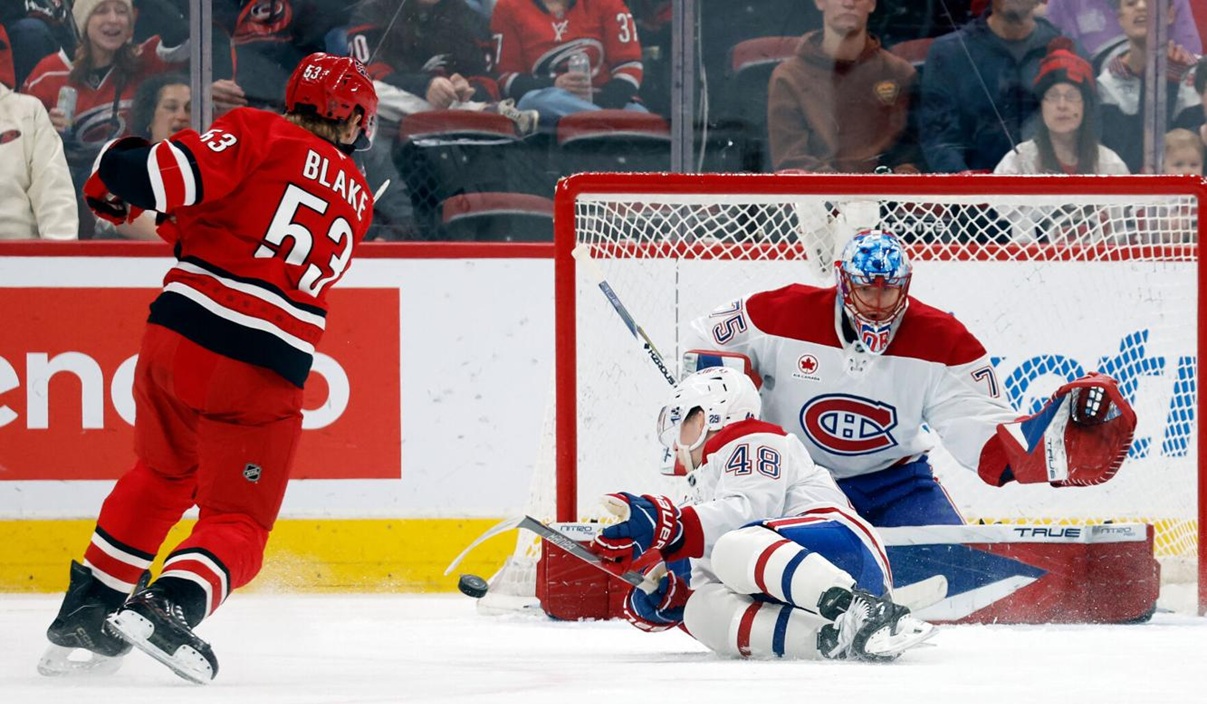
The Habs won all three games this season versus the Hurricanes. Although regular season games are generally considered a non-factor in evaluating a playoff matchup, the Hurricanes are known to be a team that insists on playing the same style and intensity both in the regular season and in the playoffs. Luckily, the matchups have been relatively recent. The first game was held on New Year’s Day in Raleigh, resulting in a 7-5 win for the Habs. Expected goals finished at 2.8 to 2.2 for the Hurricanes. Both Jakub Dobes and Brandon Bussi were not at their best that game and both teams exchanged leads in both goals and expected goals throughout the game.
The other two games were held on March 24th in Montreal and March 29th in Raleigh. Although Montreal beat Carolina 5-2 on home ice, the Habs only finished 0.1 xG better than Carolina. The main difference was Dobes, who finished the game with 2.6 goals saved above expected compared to -1.0 for Fredrik Andersen. Finally, Montreal beat Carolina 3-1 in the last matchup between these two teams. This game was a robbery for Montreal, losing the xG battle 4.8 to 2.5. Dobes finished with 3.8 goals saved above expected compared to -1.1 for Andersen.
Looking at special teams, the Habs have always struggled with Carolina’s very aggressive penalty kill. This year, they only scored one goal on eight power plays. Coupled with the Hurricanes carrying a 95% penalty killing efficiency in the playoffs, the Habs will need to find solutions in this department. Carolina’s power play has never been among the best in the league. During the playoffs, it is by far the worst of the remaining teams at 13.5%. That said, Montreal’s penalty kill has also struggled, being the worst of the remaining teams at 74.1%. During the season, the Hurricanes scored four times on eight attempts versus Montreal. Although the data is mixed regarding the special teams, the edge must be given to the Hurricanes.
There are a lot of similarities between both teams throughout their playoff journey so far. Both teams’ top guns have been pretty quiet so far. Sebastian Aho, Nikolaj Ehlers, Seth Jarvis, and Andrei Svechnikov are all below 0.60 points per game. Production has come principally from Taylor Hall (12 points), Jackson Blake (11), and Logan Stankoven (eight, including seven goals). K’Andre Miller is Carolina’s most productive defender with six assists in eight games. Montreal’s top players have been a little more productive with Suzuki at 0.93 points per game and both Caufield and Slafkovsky at 0.64, but for the latter two, all but one of these points have been on the power play. Montreal’s production has also come from secondary scoring, particularly from Newhook (nine points, including seven goals). The Habs’ best defender is Lane Hutson with the team’s top 14 points in 14 games.
On the faceoff dots, although Carolina edged the Habs by a fraction during the season, they are the worst of the remaining four teams at 46.6% in the playoffs while Montreal sits first among remaining teams at 54.1%.
What it could ultimately come down to is goaltending. Both Andersen and Dobes have been stellar during the playoffs. They are arguably both teams’ best candidate for the Conn Smythe. Anderson is 8-0 with a 0.950 save percentage while Dobes sits at 8-6 with a 0.910 save percentage. The difference here is similar to the series versus Buffalo where both Alex Lyon and Ukko-Pekka Luukkonen had been excellent to that point but known for lengthy runs of poor goaltending. Andersen was nothing short of bad this season with a save percentage of 0.874 in 35 games compared to Dobes’ 0.901 in 43 games. If there is a position where rust could play a role, goaltending is probably the most notable. Goaltenders tend to prefer consistency in their routines when they are playing well, trying to remain in their “flow state”. It remains to be seen how the lengthy break for Anderson affects his play. For Dobes, the Hurricanes could be the ideal opponent. He tends to be on top of his game when he is busy and receives a lot of shots from distance. It keeps him involved and focused. Carolina has a shoot-first mentality team and that could play into Dobes’ game.
The Habs are having a surprising run in the playoffs. They have had by far the most difficult journey, facing the Eastern Conference’s top three teams. Being ranked as the sixth-best team in the league and yet never having home ice advantage throughout the playoffs shows how the current playoff format hasn’t been favourable for the Habs. If they do reach the Stanley Cup Final, no one will be able to argue that their journey was favourable as is often said about their 2021 Cup run.