HabsWorld.net --
Before Game 1 of the third round, there was talk about the Habs making some preemptive adjustments that ultimately worked out well. Now, it’s time to go back to the drawing board as they’ve become much too predictable.
Let’s start with a simple one, zone exits. What could (and often should) be a simple play is one that sees the Habs pass themselves into trouble. They’re willing to reverse the puck three and four times and Carolina is quite content to let Montreal do just that. Then, when the time is right, they pressure and pin the Canadiens in their own end for an extended stretch. That has led to several extended shifts following turnovers and several scoring chances.
While there is a trade-off in that their patience leads to more controlled exits, it has also led to too many scoring opportunities for a puck that should have been cleared 30 seconds earlier. The Habs are a transition team but getting one more forward back to accept an outlet pass sacrifices some transition play for less defensive zone time and pressure. That’s a trade-off I think I’d take right now, given that it’s not as if Montreal’s transition game has been dynamic since the opening period of Game 1.
While we’re on the defensive front, Carolina is starting to figure out that Montreal’s defenders will panic and double up on coverage. The end result is some players getting wide-open looks and they’ve buried some of those. The adjustment here is a little trickier, however, as the Habs have played this way all season long. Their coverage strategy isn’t going anywhere so all they can hope for is their defenders stay a little more patient. Nearly 100 games into the season now, that might be asking for a bit too much.
Now, let’s look at the power play. Before going any further, Carolina deserves a lot of credit for making the man advantage struggle as much as it has with limited opportunities. This is not a one-off either; they were dominant against Ottawa and Philadelphia, as well. They are doing really well.
Montreal, meanwhile, is making it easy for them. When it comes to zone entries, all the Hurricanes have done is clog the line to force the drop pass. Then, they’ve correctly picked up on Montreal’s tendency to gain the zone and then make a quick pass back to the point. The Hurricanes put a defender right there, pick off or deflect the pass, and then reset and watch the Canadiens do the exact same thing.
To their credit, they did adjust on the one power play goal in Game 3, working a straight-line give-and-go that saw Lane Hutson score soon after on a tap-in. That’s not something they’re going to be able to do on a regular basis but varying up their zone entries (sideboards, middle, and chip-and-chase) will ultimately force the Hurricanes to be a little less aggressive, thereby ideally making the entries a little easier. I’d like to say that they need to do a better job at moving the puck once they do get set up but at this point, they’re not getting set up enough for that to be really evident.
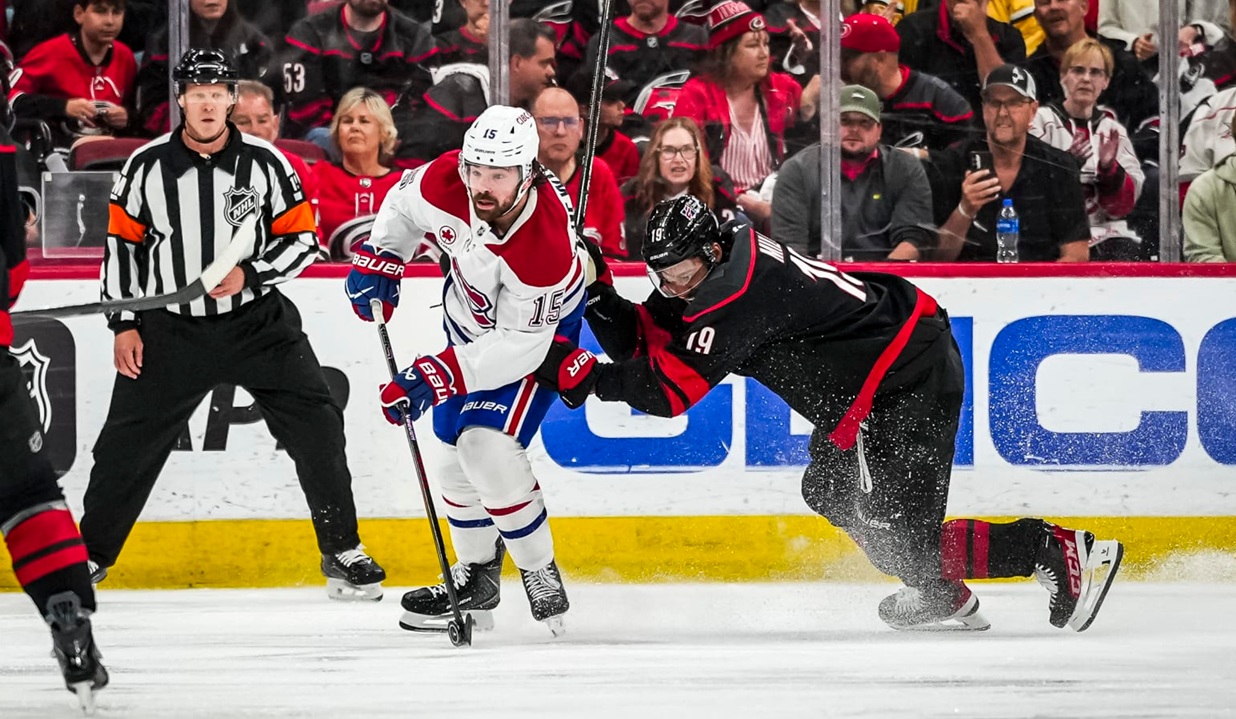
At five-on-five offensively, during non-rush plays (so, most of the time), the Hurricanes have done well at forcing the Habs into two options. After driving them to the side, they either throw it back to the point where it’s often tipped away or intercepted, or send the puck behind the net where Carolina has been better than Montreal at retrieving it. And that’s even if they get into the zone, something they struggled mightily at doing on Monday. The Habs have had some success sneaking the odd diagonal pass through (generally to the opposite point) but those are also risky. Getting another attacker closer to the puck carrier on the boards for a safer shorter pass would be a good way to mix it up and become a little less predictable.
Speaking of the offensive zone, this is one I know I’d like to see but I also know that it won’t happen. The Habs believe that no shot is better than a weak shot, in direct contrast to the Hurricanes, firm subscribers to the ‘no shot is a bad shot’ theory. That’s why there have been some big shot (and shot attempt) discrepancies in this series. This doesn’t have to involve Montreal completely changing their offensive approach, just send a few more pucks on net on a goaltender in Frederik Andersen who hasn’t been super sharp in this series on the whole. And with their unwillingness to shoot, Carolina can sit back and play the passing lanes. Mix it up a bit and once in a while, that passing lane might open up.
Overall, this isn’t going to drastically change the shot balance but if some of these tweaks lead to a couple fewer looks for Carolina and a couple more for Montreal, that’s a step in the right direction. And in a 2-1 series with two overtime games, that small adjustment or two could be a big difference-maker for the Habs as they look to tie things up on Wednesday.