HabsWorld.net --
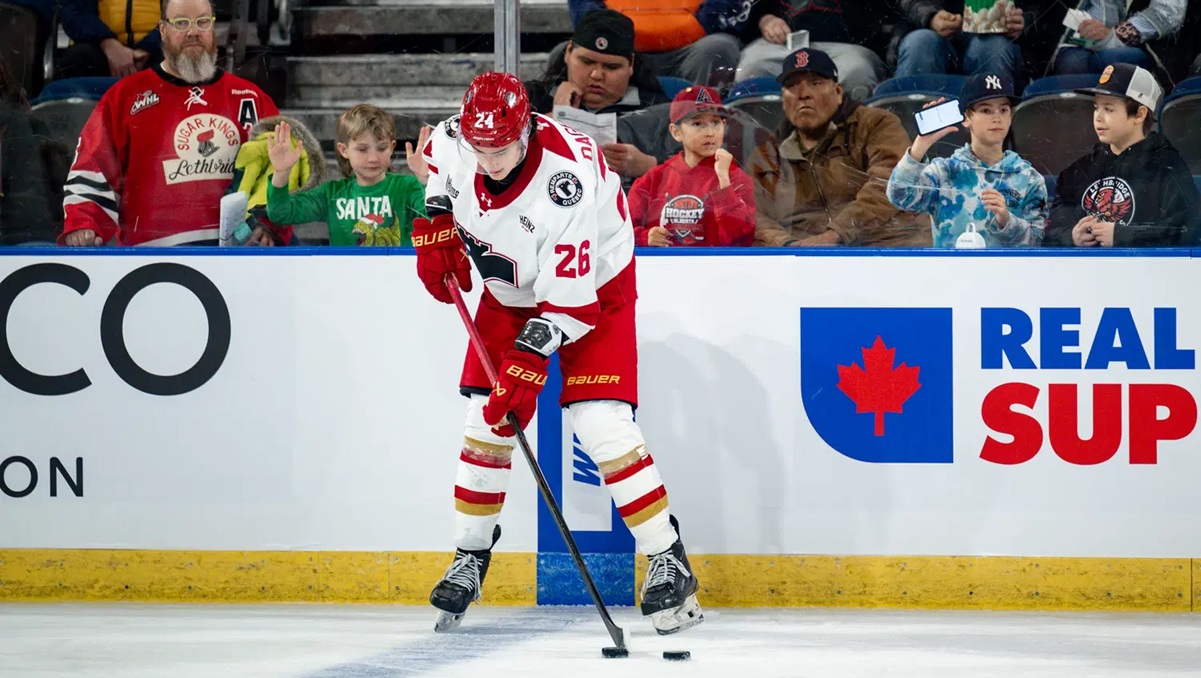
Players with size, skating ability, and a developing power-forward profile tend to rise late in the draft process, and Dagenais fits that mould perfectly. Ranked 25th on the HabsWorld list, there is a real chance he is off the board before Montreal selects at 28, but if he is available, he represents a very intriguing option. With NHL bloodlines and a game that trended strongly upward as the season progressed, Dagenais offers a blend of tools and projection that teams covet in this range.
Bio
Centre
Shoots: Left
DOB: March 27th, 2008
Height: 6′3.75
Weight: 198 lbs
Rankings
Elite Prospects: 17
Daily Faceoff: 30
The Hockey News (Ferrari): 37
The Hockey News (Kennedy): 27
TSN (Craig Button): 32
NHL Central Scouting (N. American): 15
Sportsnet (Cosentino): 22
Sportsnet (Bukala): 23
Smaht Scouting: 43
McKeen’s Hockey: 16
FloHockey (Chris Peters): 17
HPR Malloy: 25
HabsWorld: 25
Statistics
Scouting Report
Son of former Canadien Pierre Dagenais, Maddox brings a different style of game than his father. At 6’3.75, he moves well for his size and has shown a willingness to engage physically, particularly as the season progressed. After a modest rookie year in the QMJHL, he took a significant step forward this season, finishing with 62 points in 62 games and establishing himself as a consistent offensive contributor.
What makes Dagenais particularly interesting is how his game evolved over the course of the year. Early on, there were concerns about consistency and his tendency to rely too heavily on offence, but he appeared to turn a corner around midseason, beginning to impact games more regularly through physical play and effort. When engaged, he finishes checks, pressures defenders on the forecheck, and uses his frame to create disruption.
The bloodline is not completely left behind as he is a volume shooter, and his shot is another clear strength with both power and accuracy. Combined with his size, that gives him the foundation of a prototypical power forward. However, like others in this range, the question is not whether the tools are there, but whether they will be applied consistently enough to translate at the next level.
If there is one factor that could ultimately influence where he is selected, it is his positional projection. Some teams still view him as a potential centre, and if that belief holds, it could push him higher in the draft given the positional value. If not, he projects more comfortably as a winger with power-forward tendencies.
Timeline
Dagenais appears to be trending in the right direction, but he is still a projection player. His late-season improvements suggest that more development is still to come, and his timeline will largely depend on whether he can maintain that level of engagement consistently.
For the Canadiens, this is where the fit becomes interesting. Montreal can afford to be patient with its forward prospects, and Dagenais’ combination of size, mobility, and offensive tools aligns with what the organization has been trying to build. However, unlike a safer, more polished prospect, there is still some risk tied to his consistency and usage.
At 28th overall, that trade-off fits the range well. If Dagenais’ late-season progression proves to be the norm rather than the exception, he could outperform his draft slot. If not, he risks becoming another player whose tools never fully translate at the NHL level.