HabsWorld.net --
This is it. The end of the line for the 2026 draft class. Barring something completely unexpected, the Canadiens will not be picking in the top eight. Without the assets or the incentive to move up that high, this group sits outside Montreal’s immediate plans. But that does not make them irrelevant.
These are the headline prospects of the draft, and history shows that not all of them will stay put or develop as projected; remember, picks like Kirby Dach or Jesperi Kotkaniemi happen all the time. Circumstances can change quickly, and this Habs’ management group has been excellent at keeping tabs on players who could interest them later. So, examining these eight players is less about who they will draft and more about who might ultimately become available down the line.
#1 – Gavin McKenna
Penn State University (NCAA) – LW
Start of season rank: 1 Midseason rank: 2
The projected first overall pick brings an elite offensive toolkit built around vision, pace, and creativity with the puck. McKenna thrives as a play driver, regularly pushing the pace through the neutral zone while creating controlled entries with possession. His ability to manipulate defenders and open passing lanes is what separates him, though he can also finish when given time and space. He does not rely on physicality, but he competes well enough and stays involved offensively on most shifts. His production of 51 points in 35 NCAA games at Penn State has reinforced his status as the top prospect in the class, showing he can generate offence against older competition. He projects as a top-line winger who can run a power play and consistently drive play at the NHL level. Should he go to Toronto, he’ll get to grow without as much pressure too, since that team is already very offensively capable.
#2 – Ivar Stenberg
Frolunda HC (SHL) – LW
Start of season rank: 3 Midseason rank: 1
Stenberg projects to produce top-level offence while still being responsible all over the ice. He plays with pace and control through the neutral zone, but what stands out is his ability to stay involved away from the puck. He is both willing and capable defensively, which gives him added value compared to more one-dimensional offensive players. He also works effectively along the wall, extending plays and maintaining possession in contested areas. His combination of play-driving ability, effort level, and overall reliability makes him one of the more complete forwards in the class and that can be proven by his 33 points in 43 SHL games on top of 41 points in 35 international games.
#3 – Chase Reid
Soo Greyhounds (OHL) – RHD
Start of season rank: 6 Midseason rank: 4
The 6’2 right-shot defenceman stands out as one of the best skaters in the draft, with elite edge work allowing him to control gaps and escape pressure with ease. Reid moves the puck at a high pace, making quick, accurate passes that should translate well to the pro level. He is also a legitimate shooting threat from the point, with a heavy shot that gives him clear upside as a power play quarterback. His 48 points in 45 games in the OHL are proof of his offensive prowess.
#4 – Caleb Malhotra
Brantford Bulldogs (OHL) – C
Start of season rank: 19 Midseason rank: 10
The 6’2 Malhotra is the biggest riser within this top group of players by putting up a solid 84 points in 67 games as a rookie in the OHL. Malhotra has built his case through consistency and reliability in all situations. He thinks the game at a high level, consistently positioning himself on the right side of the puck and making plays that keep his team out of trouble. While he may not rely on a single standout offensive tool, his playoff production (13 goals, 26 points) showed he can contribute when games tighten up. His combination of hockey sense, reliability, and ability to play in all situations gives him a strong projection as a top-six centre at the next level.
#5 – Carson Carels
Prince George Cougars (WHL) – LHD
Start of season rank: 14 Midseason rank: 9
Carels is a meat-and-potatoes type of defender that coaches learn to appreciate quickly. He can be relied upon in all situations. His game is built on strong decision-making and consistently moving the puck with purpose. He rarely overextends offensively, but his production took a notable step forward this season, with 73 points in 58 games. Defensively, he plays with commitment, engaging physically and using positioning and strength to win battles. While he may not have one defining elite trait, Carels excels across the board, projecting as a dependable top-four defenceman who can contribute to all phases of the game.
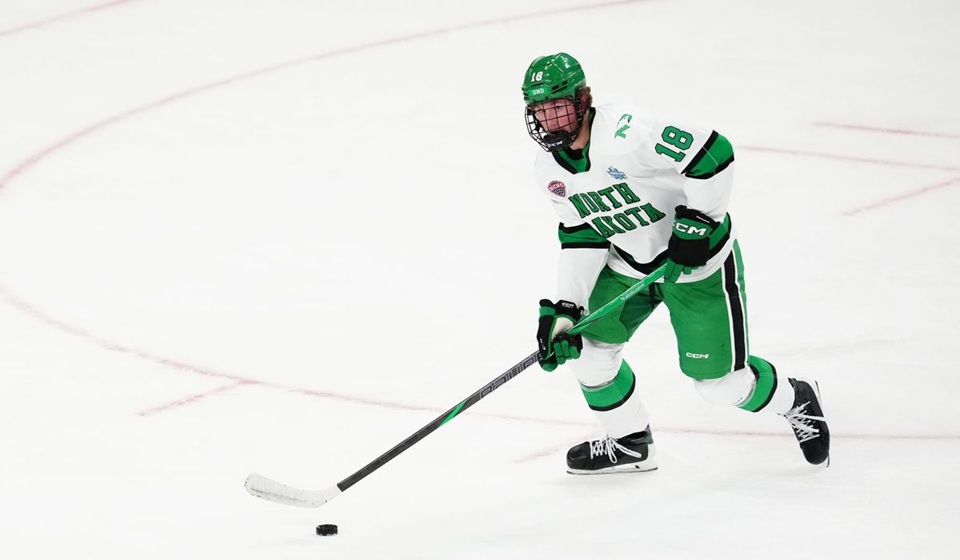
#6 – Keaton Verhoeff
University of North Dakota (NCAA) – RHD
Start of season rank: 2 Midseason rank: 3
The 6’4 defender is firstly defined by his agility, as he excels at small area plays and at walking the line. He’s had a more successful adjustment to the NCAA than many despite an average stat line of 20 points in 36 NCAA games. His offensive instincts are not in question, but there are concerns about his straight-line speed, though most believe that an increase in raw strength will handle this because his stride is there as shown by his off-the-charts agility. The defensive reads are usually sound but his decisions off the reads can be a bit raw at times. His size and the fact that the qualities he possesses are the harder things to teach make him a very interesting option at the top of the draft. However, it is worth noting that this is definitely a ceiling pick as opposed to the far more polished play of the rest of this top eight.
#7 – Alberts Smits
Jukurit (Liiga) – LD
Start of season rank: 18 Midseason rank: 6
The well-travelled Latvian defenceman brings one of the most unique profiles in the draft, having already logged significant experience across multiple professional leagues and international tournaments. Over the past year, the 6’3 Smits has played at the U18, U20, and senior levels internationally, including an appearance at the Olympic Games, while also taking on meaningful minutes in both Finland and Germany. That level of exposure shows in his game, as he plays with confidence and executes decisively whether the puck is on his stick or not.
While others in this range may offer more raw upside, Smits makes his case through experience, reliability, and a pro-ready approach to the game. His combination of maturity, versatility, and consistency gives him a strong projection to step into a lineup earlier than most, which is reflected in his rise throughout the season. If that sounds like a profile Habs fans know well, it sounds rather similar to that of David Reinbacher before the Habs made him the fifth selection in the 2023 draft. Hopefully, the team that goes down this path will see a player continue the upwards trajectory better than the oft-injured Reinbacher.
#8 – Viggo Bjorck
Djurgardens IF (SHL) – C
Start of season rank: 9 Midseason rank: 8
The undersized centre had a productive season in the SHL with 15 points in 42 games, but even more impressive was his 36 points in 37 international contests. He has a relentless motor that allowed him to stand out at the World Juniors, where he recorded nine points in seven games for Sweden in what became a true coming-out party. Bjorck consistently pushed the pace and created offensively, while also showing responsibility away from the puck, winning over 54% of his faceoffs during the tournament.
He plays a high-tempo game, processing plays quickly and working ahead of his opponents, which allows him to stay involved in all three zones regardless of the level of competition. Bjorck does not shy away from pressure situations either, regularly taking key draws and handling top minutes against strong opposition. While his size remains a limiting factor compared to others in this range, his pace, intelligence, and competitiveness give him a strong foundation to project as a middle-six centre who can contribute in multiple situations if his game continues to translate.