HabsWorld.net --
During the 2022-2023 season, Martin St-Louis knew that he needed to find the best partner for his best duo of Nick Suzuki and Cole Caufield. Many attempts were made with Christian Dvorak, Sean Monahan, and even Mike Hoffman for a few games each. By year-end, it was Josh Anderson (19 games) and Kirby Dach (33 games) who spent the most time with the duo. Of these two, Anderson was by far the worst option although Dach was barely above average.
The following year was the first attempt at joining Juraj Slafkovsky with Suzuki and Caufield and they played 64 games together, by far the most regular combination that season. Their underlying stats were much better than with Dach the previous year, scoring the bulk of the team’s goals at five-on-five. Slafkovsky was still finding his game at that time and fans were getting impatient with his production, occasionally seeing glimpses of what it could be. Of course, consistency is always an issue for young players. This was no different for Slafkovsky. Hope remained high, though, with a much better second half of the season.
Last season, it seemed clear that the Slafkovsky-Suzuki-Caufield line would be the team’s staple first line for years to come. Although Slakovsky had another slower start to the season, it was the second-most regular trio behind the veteran Gallagher-Dvorak-Anderson line. Their underlying stats were among the best in the league as all three continued their progression in both point production and defensive play. Facing the opponent’s top lines game after game did very little to stop their progression. All was set for an even better season in 2025-2026.
Until Ivan Demidov came along.
The new phenom raised eyebrows when he arrived at the end of last year. As for Lane Hutson the previous year, the last few games of the regular season were enough to notice that he was a high-end talent that needed to be well surrounded. St-Louis matched him with two defensively responsible players in Alex Newhook and Jake Evans in the first round of the playoffs against Washington. Although this line didn’t create as much as management would want, they remained sound defensively.
At the beginning of the current season, St-Louis was much more focused on who would play with the rookie Demidov than his first line. Placing Oliver Kapanen at centre with Demidov and Newhook seemed to work very well. The first line remained hot with excellent production and underlying advanced stats while the new second line with two rookies in Demidov and Kapanen played relatively well defensively while showing improvement as the season progressed. Unfortunately, Newhook broke his ankle on November 13th against Dallas and the next day it was announced that he would be out for eight to ten weeks.
During the game against Columbus on November 17th, Slafkovsky was inserted with Demidov and Kapanen in the second period for the first time, resulting in Kapanen’s 7th goal of the season assisted by Demidov and Mike Matheson following a great offensive zone possession by Slafkovsky. The next game versus the Capitals was an 8-4 loss for the Habs and St-Louis played with his lines during the game, attempting to create a spark. Although the effort was in vain, it seems that the coach liked what he saw from the kid line of Slafkovsky-Demidov-Kapanen and they were put together again the next game against the Maple Leafs. The Habs 5-2 win was not only a dominant one, but the newly formed kid line was outstanding, being on the ice for two of the team’s goals.
St-Louis was now stuck with a dilemma between keeping Slafkovsky with Caufield and Suzuki, which was doing quite well, or with Kapanen and Demidov which not only seemed to make Demidov much more of an offensive threat, but showed a ‘new’ version of Slafkovsky that was not apparent with the top line. Slafkovsky was taking charge of the play on the kid line, possessing the puck much more. With Demidov’s ability to find open ice and Kapanen’s scoring touch, this new combination could provide St-Louis with a threatening one-two punch for the future.
So we are back to 2023. Who can take the spot on the first line?
Understandably, the first thought that comes up is who can play like Slafkovsky? It seems obvious that Suzuki and Caufield needed a hard forechecking winger who could recover pucks along the board and feed the two top scorers of the team. Anderson clearly fit the profile but that experience had not been successful before. Zachary Bolduc received an audition for this role first. Bolduc was producing at a decent rate playing with Brendan Gallagher and Dach. He had a great shot, was physical along the boards, and did well as a net front presence. Success came early when the Habs played versus the Mammoth in Utah. In a 4-3 win, Suzuki (2G, 1A) and Bolduc (1G, 2A) were the first two stars of the game. Unfortunately, the success was short-lived and the line struggled at times. The experience wasn’t a flop by any means; underlying stats were decent, but inconsistent.
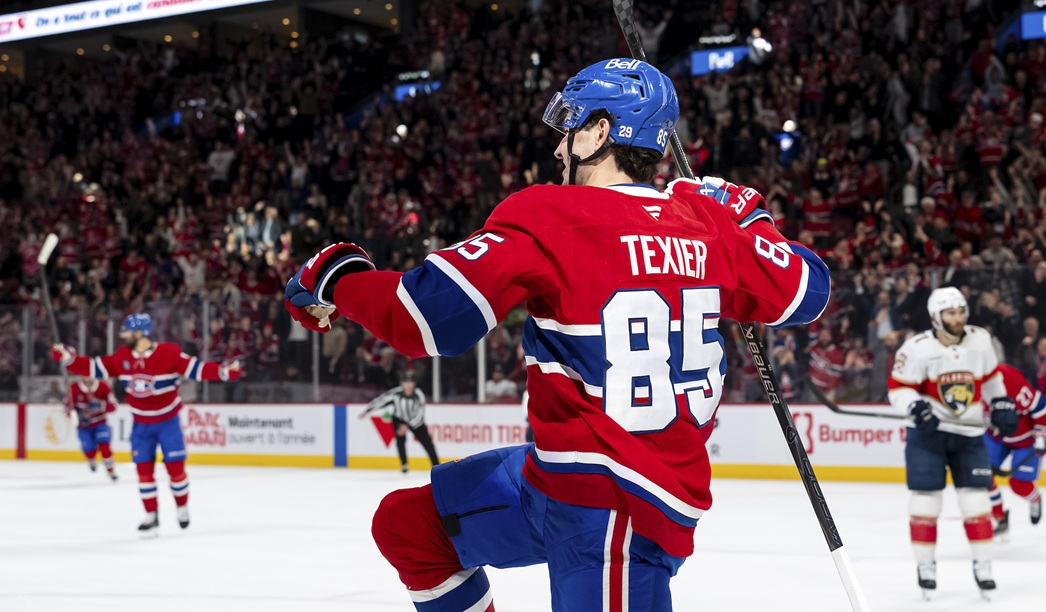
On November 23rd, the Canadiens signed Alexandre Texier who had terminated his contract with the St. Louis Blues. With Newhook gone for a while, he was seen as a good depth piece. Texier had shown in Columbus that he could be a top-six forward in the NHL but following personal issues in Europe that took his mind off his career, and a stint with the Blues where he struggled to find his game, he opted to terminate his contract and test the market. When Montreal called him, he knew this was a chance he couldn’t pass on.
Texier played his first game on November 28th versus the Golden Knights with Evans and Anderson. Texier played very well, assisting Evans on the Habs’ third goal in a 4-1 win. In December, the Suzuki-Caufield-Bolduc line was producing at five-on-five but not at the rate they were with Slafkovsky. Meanwhile, Texier was producing better than expected with Evans and Anderson with three goals and three assists over the period. After the Christmas break, St-Louis decided to replace Bolduc with Texier on the first line in Tampa Bay, trailing 3-0 in the second to get a spark. As is often the case with line combinations, mid-game changes turn into a longer audition for a player and Texier became a regular with Suzuki and Caufield. More recently, Texier has been sidelined due to injury. Dach’s progress on the bottom six after a long-term injury has given him another audition on the top line.
With the Kid Line producing well and continuing to show progress together, it seems less and less likely that Slafkovsky will return to the first line as a regular. St-Louis does occasionally rely on that line late in games when a tying goal is needed but his two lines have been quite stable since Christmas. At this point, it would be premature to think that Texier is a long-term solution on the first line.
Now that both Texier and Bolduc have had a good number of games with the top duo, it is interesting to go deeper into the advanced statistics and see how they compare. Among the most telling five-on-five statistics, Goals% (percent of goals for/total goals on ice), Expected Goals% (same as Goals% but for high danger chances), Corsi (%shot attempts For/Total shot attempts on ice), and Fenwick (same as Corsi but excluding blocked shots) are widely used to compare different lines in the league. The latter two (Corsi and Fenwick) are often regarded as puck-possession comparables. The idea here is that a line with a majority of shot attempts (greater than 50% of total) has possession of the puck more than the opponent. Fenwick adds an element of quality of shots produced using only unblocked shots.
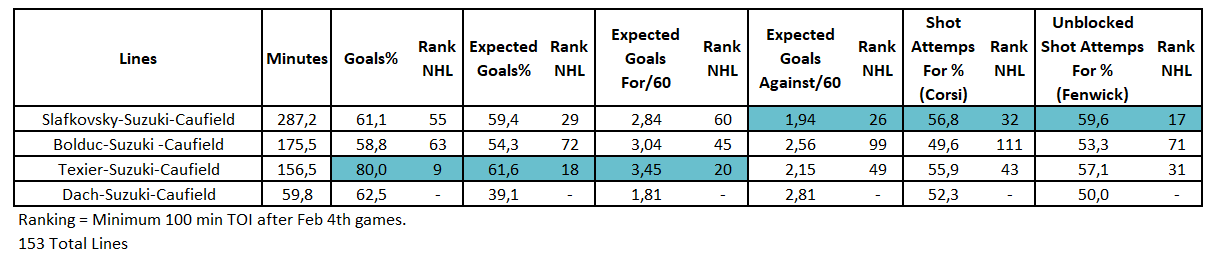
The table below shows the different advanced stats from MoneyPuck for Slafkovsky, Bolduc, and Texier on the first line. The NHL ranking presented is based on a minimum of 100 minutes TOI together and include a total of 153 different line combinations in the NHL. For reference, the newly formed Dach-Suzuki-Caufield data is also presented. With less than 60 minutes played together, the data should be taken with caution. More minutes will undoubtedly improve the chemistry and hence the data presented. Nonetheless, it does show where that line is so far compared to other options.
(You can click on the image for a larger version.)
If the discussion is to choose between Bolduc and Texier, the conversation will be a short one. Texier blows Bolduc out of the water on every parameter. Surprisingly, though, the Texier audition has also been a better option than Slafkovsky on all three purely offensive parameters, even ranked in the top 10 lines in the league in Goals%, and the top 20 in Expected Goals% and Expected Goals/60 min. When looking at defensive and puck-possession parameters, Slafkovsky is better than Texier on the first line but the Texier option is a close second. An interesting constant is the fact that all options show Goals% higher than the two Expected Goals parameters. This is not very surprising, really. The Habs have held a top-five rate in the league in shooting percentage all year. They are scoring at a higher rate compared to their expected goals, more than most teams in the league.
As far as the Dach audition is concerned, unsurprisingly, they are on the receiving end of scoring chances from the opponent so far, although their Goals% is well above 50%. Their Corsi and Fenwick numbers are a little above average as well. It remains to be seen how much patience St-Louis will have with this trio once the schedule resumes in late February, assuming everyone is healthy at that point.
When comparing to the league, although the Texier option is top 10 in Goals%, their remaining stats don’t put them among the elite in the league. Offensively, it would qualify as one of the better lines for sure, but not yet elite. Whether this is a symptom of a team that offers way too many scoring chances defensively or that the ideal third man on that line remains to be found (or both), the Habs first line of the future will need to be better in order to become a true Cup contender.