HabsWorld.net --
The title may sound harsh, but with a faint echo of Julie Andrews softening the blow, it captures the challenge now facing the Montreal Canadiens with their enigmatic winger. With trade rumours swirling and a roster crunch looming after the Olympics, the situation resembles a game of musical chairs—two players added, one chair removed.
The imminent return of Alex Newhook, combined with the arrivals of Alexandre Texier and Philip Danault, means a former star who was already pushed to the fourth line before injury may find himself without a seat. Hard to believe, considering the excitement last summer when Kent Hughes pulled off a master stroke: flipping Jordan Harris to Columbus for Patrik Laine and a second-round pick (later moved for Danault). The Finnish sniper had burned his bridges with the Blue Jackets, and Don Waddell simply wanted out from under the contract. Was it a sign of a problem player—or a problem environment?
The Pedigree and the Path Here
To understand the present, you have to revisit the promise. Drafted 2nd overall in 2016 behind Auston Matthews, Laine was widely viewed as the next-best player in a class that included Matthew Tkachuk, Charlie McAvoy, and Tage Thompson. His first three NHL seasons were electric. He narrowly lost the Calder to Matthews—despite posting a higher points-per-game rate (0.876 vs. 0.829)—and followed it up with over 120 goals and 200 points in his next 250 healthy games. He became the fourth-youngest player in NHL history to reach 100 goals.
But storm clouds gathered.
The first real challenge wasn’t injury—it was his RFA contract. With numbers second only to Matthews, Laine was due a major payday. Negotiations stalled, he held out, and he began the season in Switzerland. Eventually, he signed a two-year, $13.5 million bridge deal. Compared to Matthews’ five-year, $58 million contract and Tkachuk’s three-year, $21 million deal, it was a bargain for Winnipeg. He still produced 63 points in 68 games despite no training camp, but a wrist injury in the playoffs lingered.
By the start of 2020, he had played just one game. Kevin Cheveldayoff finally swapped one “problem child” for another, sending Laine to Columbus for Pierre-Luc Dubois and a third-round pick.
His time in Columbus was rocky from day one. Injuries persisted, frustration simmered, and questions about his commitment grew. When he played, he produced at a point-per-game pace—but keeping him on the ice was the challenge. The ending felt inevitable.
Montreal: Hope, Heartbreak, and a Flicker of Magic
Laine’s first season in Montreal can be summed up by two moments.
The first was his preseason debut at the Bell Centre—the roar of anticipation, followed by the collective gasp when a reckless hit from a Leafs fringe player shredded his knee. He was clearly in agony, yet desperate to continue.
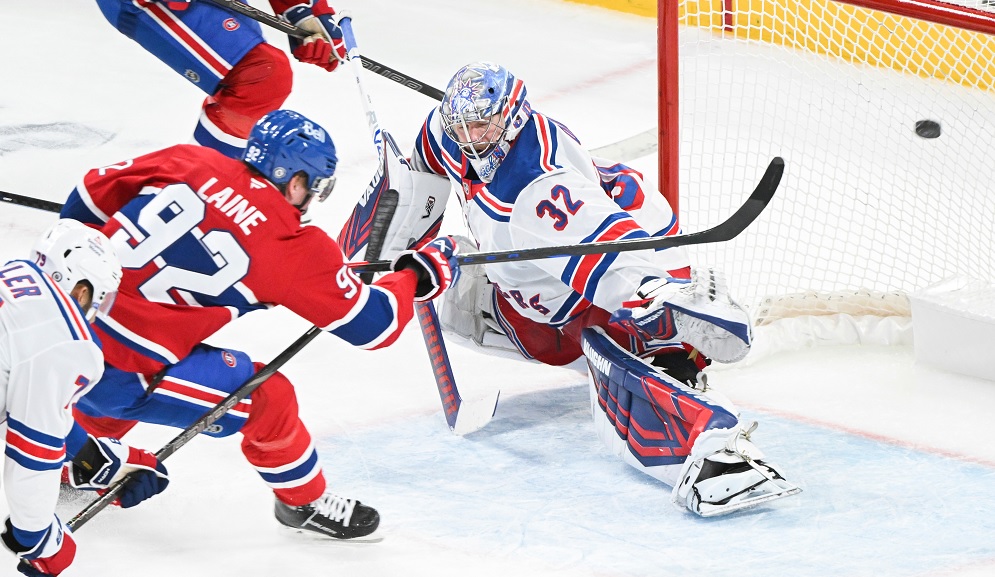
The second came after a 24-game absence. In his first game back at the Bell Centre, he scored his first Habs goal. The eruption from the crowd, the joy on his teammates’ faces, and the look on Laine’s own face—it was genuinely heartwarming. Even on one leg, he became a power-play weapon and a catalyst for a young team pushing toward the playoffs.
This season, hopes were high that he’d find chemistry with Ivan Demidov on the second line. But again, something was off. His first step lacked pop, his trademark one-timer was misfiring, and it was no surprise when a core muscle injury was announced.
A Comparable Case: Alexei Kovalev
In researching this piece, one name kept resurfacing: Alexei Kovalev. Kovalev, too, was a mercurial talent—brilliant, frustrating, laid-back, and capable of taking over a game single-handedly. After early success in Pittsburgh, injuries and inconsistency followed him to New York before he eventually landed in Montreal for a pair of second-round picks. Sound familiar?
After a tough first year (and the lockout), he became a star and a fan favourite. The game slowed down when he had the puck. He gave Koivu the elite winger he’d long been denied.
There are other examples of injury-plagued stars who found second winds: Steve Yzerman, Peter Forsberg, Cam Neely. There is precedent for Laine to do the same.
The criticism in Columbus was that Laine didn’t “love hockey” the way those players did. But Kovalev was accused of the same. Personality isn’t passion. Some players burn quietly.
A Different Kind of Recovery
This time, Laine’s recovery has felt different—slower, more patient, more deliberate. The Canadiens have used the Olympic break to evaluate him privately: his fitness, his appetite, and how he fits into a team that has grown faster, more confident, and more mature since last January.
So, What Happens Now?
In the short term, everything is on the table. What won’t happen is a knee-jerk trade or public shaming. Jeff Gorton and Kent Hughes operate with class and humility. They’ve handled every contract expiry with respect—no holdouts, no lowballing, no drama. They reward players with fair deals that show confidence. Imagine how differently Laine’s career might have unfolded if he’d had that in 2018.
As a fan, I hope he gets a real chance after the Olympic break—on a top line, with top talent. A fully healthy Laine, even at 80% of his Jets form, would give Montreal a terrifying top six.
But my prediction is more cautious. I think he’ll get a chance—but may struggle to fit. His pace doesn’t match the current top six, and the second line is untouchable. That leaves the top line, where he overlaps too much with Caufield: two right-handed shooters hunting the same off-wing circle. Three righties on one line all looking for the same space isn’t ideal.
Which leads to the likely outcome: a trade.
Not a punishment—an opportunity. A move that gives Laine a genuine chance to play meaningful minutes and earn his next contract. Twenty-five points down the stretch is entirely realistic if he’s healthy.
With prospects like Michael Hage and Alexander Zharovsky approaching, the writing may be on the wall. But my hope is that Montreal has rekindled his love of the game—and that he still has a long, successful career ahead.