
HabsWorld.net --
Much has been said about the Habs’ defensive game since the beginning of the season. Rightfully so. With a 3.28 Goals Against Average per game, ranked 24th in goals against in the league (187), it is certainly the most glaring issue that the team needs to resolve. The culprits have been plenty as well, but the most common have been goaltending, Martin St-Louis’ defensive system (hybrid man-to-man), and the discipline/penalty killing performance. The latter point has also included critics of officiating, ranging from a lack of consistency to a league-wide conspiracy with the objective of sinking the Montreal Canadiens. Although criticism towards NHL officials is arguably warranted to some degree, this analysis focuses on issues that Montreal’s management and coaching staff can control, namely the players and how they play the game.
Two teams have been used as comparables, both known to use a similar defensive structure as the Habs, but among the best in the league in goals against. The Tampa Bay Lightning are second in the league with 140 goals against and the Los Angeles Kings are fifth with 161 goals against. These two teams are in a very different place in the standings, mostly due to the lack of offence coming from the Kings with 146 goals for, tied for 31st in the league.
For each of these teams, every goal against was reviewed and slotted in five different groups. Empty Net goals allowed were removed from the dataset as they have no influence on the team’s save percentage. For the record, both Montreal and Tampa Bay have given up seven empty-net goals and Los Angeles has allowed eight. The definition of each group needs to be stated clearly as it will help to understand what the data means in the end. In addition, there are some goals that fall somewhere between two groups and understanding where the line was drawn provides a better image of the results.
Rush: Goals off the rush are generally easy to identify. Sometimes, though, a goal is not scored on the first shot, but after a rebound or a recovery in the corner and a quick pass in front of the net, producing a goal, can also qualify as a rush goal in this dataset. The definition used is whether or not the defending team was able to establish its position in the defensive zone prior to the goal.
Cycling/Zone Time: Goals from cycling the puck and/or following zone time possession by the opponent would be a typical goal in this group. Again, the definition is based on the ability of the defending team to establish position in the zone prior to the goal. These goals typically result from the defending team’s inability to execute the established defensive structure.
Faceoffs: Goals allowed off the faceoff are often the result of a set play that was either misread or the inability of the defending team to establish position quickly in the zone prior to the goal. They are relatively rare in general and are not significantly pertinent to a team’s defensive structure.
Not 5 on 5: These are goals scored in various situations where special teams are involved. Most of them are on the penalty kill, but shorthanded, 3-on-3 overtime, 4-on-4, or 5-on-6 with an empty net goals are also included here. Although it is a significant amount of the total goals allowed, they can be grouped as ‘’special teams’’ goals against.
Others: Put simply, these are goals that don’t fit any of the above groups. Among these, the most common are goals resulting in a defensive zone turnover or giveaway, or immediately after a penalty is finished and the team was unable to set up defensively prior to the goal.
(Click on the image for a larger version.)
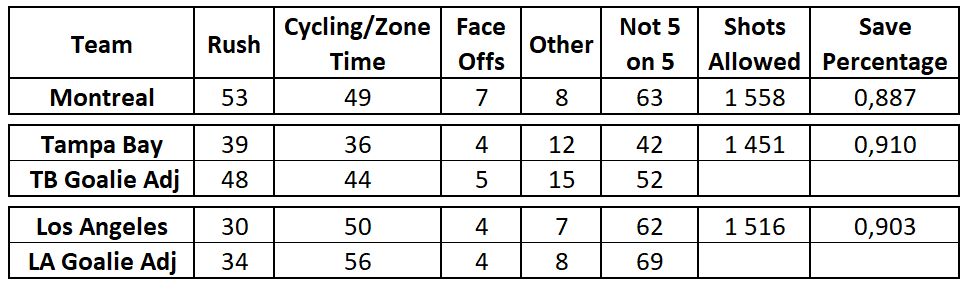
For both Tampa Bay and Los Angeles, the totals are recalculated as ‘’Goalie Adjusted’’ which represents the number of goals that would be allowed by that team if their Save Percentage was the same as that of the Montreal Canadiens. Although the argument is somewhat debatable as it doesn’t account for shot quality allowed, it can be used as an indication of the impact of goaltending on the goals allowed compared to other teams.
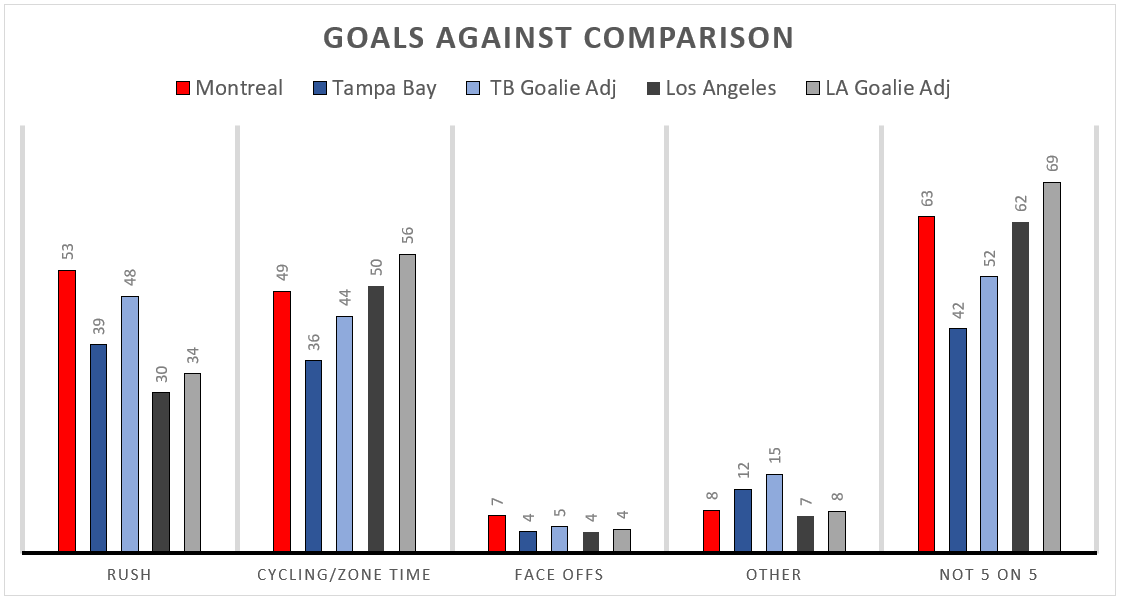
The data is presented below as histograms for a better visual representation.
(Click on the image for a larger version.)
Among the less impactful groups of Faceoffs and Other, Tampa Bay has given up a surprising number of goals following a D-Zone turnover. Nine of the 12 goals allowed in this group are in this subset. Considering that Tampa Bay is one of the best defensive teams in the league, this was not expected.
Looking at the ‘’Not 5-on-5’’ group, Tampa Bay stands out from both Montreal and Los Angeles, which are both quite similar. Among these, Montreal has allowed 37 standard penalty killing goals at 4-on-5 and Los Angeles has allowed 38 (24th and 26th in the league, respectively). Tampa Bay has allowed 27, ranked ninth in the league.
Both Rush and Cycling/Zone Time groups can be qualified as the main 5-on-5 subgroups. Rush goals allowed can be attributed to a team’s level of risk-taking in the offensive zone, which results in an odd-man rush the other way, and/or their inability to recover from an offence-to-defence transition. Cycling/Zone Time is essentially a representation of the team’s D-Zone structure and its ability to deny scoring chances when the opponent controls the puck in their zone.
Los Angeles is extremely good at limiting Rush chances. This is undoubtedly attributable to both their ability to recover from loss of puck-possession, but also a testimony of their ability to properly evaluate risk in the neutral and offensive zone. This is by far the main differentiator between Los Angeles and Montreal. There is a cost to this, though. With limited offensive talent, the Kings rely heavily on reducing risk-taking in the offensive zone and prioritize defence.
Tampa Bay is basically good at both. Although they give a few more rush chances to opponents than Los Angeles, they are better than both Montreal and Los Angeles at defending against cycling. Considering their 195 Goals For ranked fourth in the league, just behind Montreal, they have evidently found the sweet spot between offensive zone risk-taking and quick offence-defence transition to limit quality chances allowed. Their defensive game is good enough to even allow a few more brain-freeze defensive zone turnovers than other teams.
So what does that mean for the Habs?
For starters, looking at the Goalie Adjusted numbers, goaltending is a large contributor to the difference in goals allowed. Compared to Los Angeles, for example, the Habs are arguably as good in defending against the cycle. Compared to Tampa Bay, their save percentage difference accounts for more than half of the difference in goals allowed in both groups.
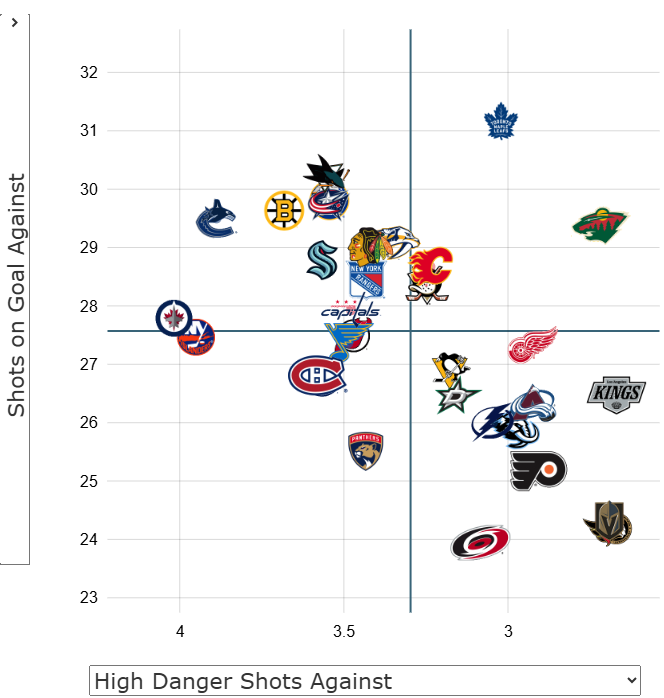
Of course, Save Percentage is not the only metric to estimate the contribution of goaltending on the difference. Looking at the Shots on Goals Against vs High Danger Shots Against can help us determine if the Habs goaltenders are facing more difficult shots than the Kings and the Lightning. Based on data from MoneyPuck, Habs goaltenders are receiving 0.5 High Danger shots per game more than Tampa Bay and a little less than 1.0 High Danger shots per game more than Los Angeles. This difference is observed both in All Situations and 5-on-5 alone. All three teams concede between 26 and 27 shots per game. Although the Habs do in fact offer more high-danger chances, it is hardly enough to justify the difference in Save Percentage between the three teams.
(Click on the image for a larger version.)
Regardless of goaltending, the data also suggests that although some improvement in the team’s Defensive Zone structure is justified and could contribute to better defensive numbers, more gains could occur by improving the penalty kill and by reducing rush chances. Improving both of these would also help reduce the high-danger shots. Odd-man rushes typically produce more high-risk shots on average than on the cycle. By definition, a reduction of rush shots would have a bigger impact on goals allowed than the same reduction in cycle shots.
The issue with reducing rush chances, though, is that it requires a change in offensive zone philosophy. This will inevitably reduce the Goals For. The Habs’ offence is relying heavily on their defencemen to pinch in the offensive zone and contribute to the attack. Montreal’s back end has totalled 156 points so far this season, compared to Tampa Bay (139) and Los Angeles (86). The end result is a high-octane offence which ranks tied second in the league with 199 Goals For. Ironically, they are tied second with Tampa Bay, who have elected to sacrifice some rush chances to their opponent in order to produce more offensively, but are much more effective shorthanded (ranked fourth in the league), and are a very efficient team against the cycle.
What transpires from this analysis is that there isn’t a single issue that can be pointed at to explain the Habs’ defensive struggles. Many of the deficiencies are typically characteristic of a younger team. A lack of discipline and a risk-taking offence is very common with talented young teams. Goaltending has been an issue all year, so seeing this come out in the data is a surprise to no one. Although the team’s hybrid defensive structure does allow more goals than it should, the data suggests that it is not at all the main issue. Montreal’s Shots Against is not significantly higher than other teams this year, ranked 13th-lowest (compared to 23rd last year). Clearly, increasing the Save Percentage to that of Los Angeles or Tampa Bay would reduce the number of goals allowed by at least 20-30 goals, putting them in the Top 10 lowest in Goals Against. Improving the penalty kill by 6 or 7% (among the top 10 in the league) wouldn’t have as much of an impact. Between Cycle goals allowed and Rush goals allowed, the team would gain more benefit from improving the latter, although that could also affect the offensive production more than improving the defensive game against the cycle.