
HabsWorld.net --
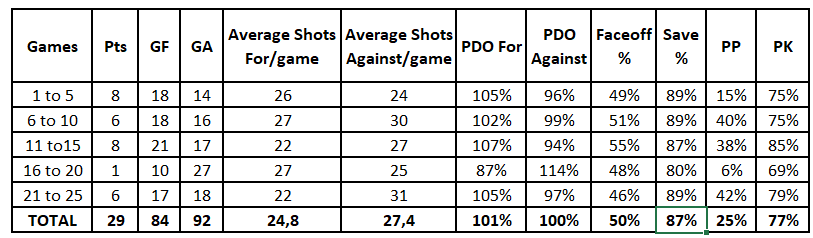
The last five games of the Habs highlight the team’s immaturity, youth, and lack of experience. It is a tale of two extremes, showing the best (vs the Maple Leafs and the Golden Knights) and the worst (vs the Avalanche and the Senators).
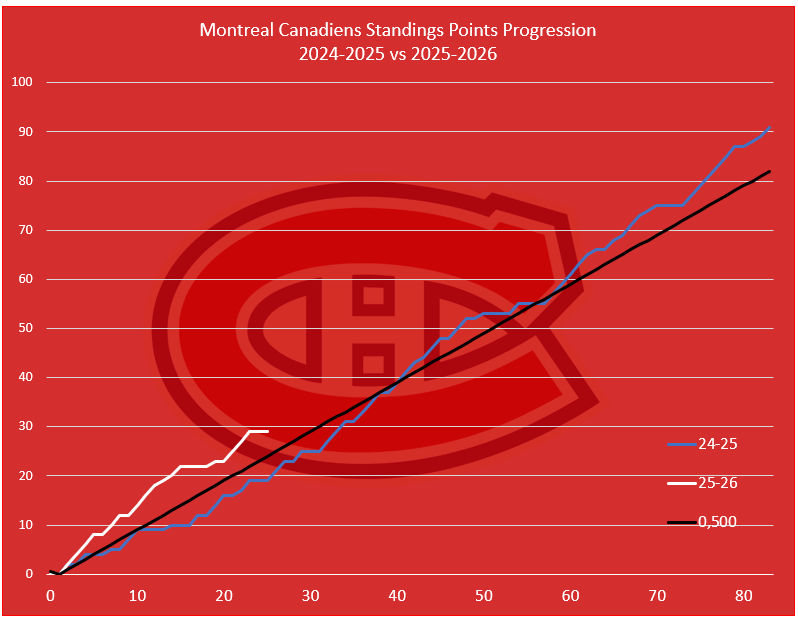
The Habs collected six points out of ten in this latest five-game segment. Anytime a team plays 0.600 hockey, their chances of making the playoffs are very high. Their PDO is fine, faceoff percentage is average, and the power play and penalty kill rates combine to 102% which is 13th in the league. The major issue here is the save percentage which ranks worse than all teams in the NHL besides Edmonton and Nashville.
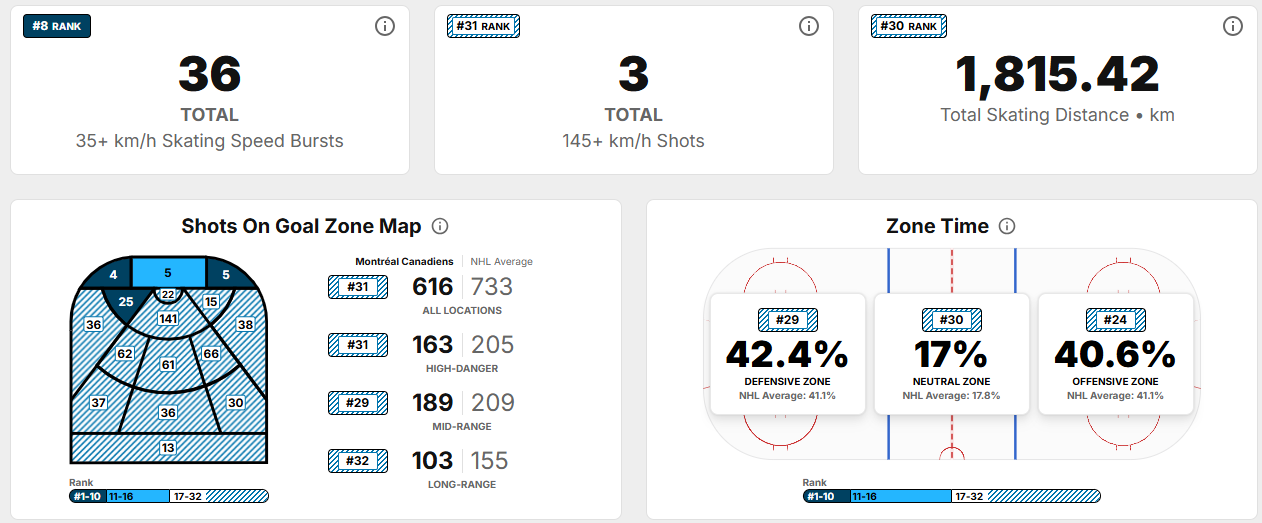
Advanced stats presented by NHL Edge have stabilized over the last few weeks. They continue to spend more time in the defensive zone than most teams and don’t produce a lot of shots. That said, they continue to rely on their accuracy as they are still top of the NHL in shooting percentage with 13.6%.
It would be unfair to put the blame entirely on the goalies for the last five games. Both Dobes and Montambeault have had good outings in Utah and Vegas. What the data suggests is that the team cannot rely on spectacular goaltending this year like they had last year with them. The average-to-below-average goaltending that the team has had so far exposes the defensive flaws in the team and although this is very frustrating to watch, it could be a long-term blessing in disguise.
The frustration is also quite evident when listening to Martin St-Louis’ post-game interviews. He consistently mentions the “standards” that the team has set for themselves and how they cannot seem to reach them on a consistent basis. St-Louis did take part of the blame after the meltdown in Colorado. He modified the defensive structure, thinking it would help the team defend against an experienced fast team, especially on the second game of a back-to-back.
The plan was basically to clog up the neutral zone with all five players and cut passing lanes. This is a very passive approach that is not very different from Jacques Lemaire’s New Jersey trap system which was very successful in the 1990s. The reason this system doesn’t work as well in today’s game is that holding, hooking, and interference were basically legal back then, so slowing down a fast team was relatively easy if you clogged the neutral zone with players. Under the current application of the rules, the Avalanche were able to enter the zone with speed and the Habs defencemen were forced to back off and give the blue line, creating a large gap in the high slot.
Normally, St-Louis’ defensive structure involves fast forecheck and neutral-zone squeezing with tight back pressure at both blue lines. The team’s DNA is structured around that and they do have the speed upfront and on the back end to do that effectively, but it does require that all five players be well-positioned and able to anticipate plays. That’s what St-Louis means when he talks about being “balanced” on the ice. The team is in the process of learning how to react and defend when the balance is missing. Since there are a myriad of ways this can happen, experience is the only way to learn how to adapt to these situations.
It needs to be repeated, the Habs are a very young team. With six rookies in the lineup most nights (of which three are replacing injured key players), the average age is even lower than with a healthy lineup. The recent signing of Alexandre Texier did tamper that somewhat, but the team is still young, inexperienced, and in a learning phase. Their talent alone is helping them win more games than they lose, which, in itself, bodes well for the future. What we are witnessing are the growing pains that will eventually result in a team feared by most in the league as long as the management remains patient and doesn’t bend to the media and fan base pressure. So far, Hughes and Gorton haven’t shown any sense of urgency to move.