

In the 2024-2025 season, the Montreal Canadiens finished with an impressive 91-point regular season, a 15-point improvement over the previous season, surprising many in the league. In addition, they qualified for the final playoff spot and a first-round matchup against the Washington Capitals. While they lost in a five-game series that was lopsided at times, the team gained valuable experience and management got to see first-hand the challenges they needed to address heading into future seasons.
After completing the 2025/2026 season we can look back and evaluate how the changes from the management team of Kent Hughes and Jeff Gorton worked out. All stats provided by www.hockeyreference.com.
Team Performance
The first and really the only thing that matters is how the team has performed. In order to measure performance, we’ll compare 2024-2025 to the 2025-2026 season.


If nothing else, just knowing the team finished fifth overall is nothing short of impressive. I don’t think anyone would have predicted the team would improve by 15 points when they had already reached 91 the previous season. Truly a remarkable season for the team. But the big question to answer is how? How did the team improve so much? What drove their success? When we look at team performance, one number stands out and that’s their offensive performance.


Scoring 40 more goals than the previous season (+16% improvement) and ending up as the seventh–best scoring team in the league is no small feat. The biggest contributors on the team were Cole Caufield and Juraj Slafkovsky’s career seasons, combining for 81 goals in total and 26 of the 40-goal improvement season over season. The other major source of improvement was goal scoring from the defence, which jumped from 25 goals to 43 goals. Led by a full season of Lane Hutson and Noah Dobson (each with 12 goals), the defence provided a big boost to team offence. Other new contributors like Ivan Demidov and Oliver Kapanen largely offset the loss in production from Patrik Laine and Brendan Gallagher from the previous season.
On the flip side, the defence slightly improved year over year as the team allowed 10 fewer goals against compared to the year before. Having said that, the team still finished in the middle of the pack in the league and in the playoffs, the defensive structure was exposed as a major weakness.
Overall, while the team slightly improved in defence, the 2025-2026 season was clearly driven by offense. So how did the team generate more goals? Was it special teams?


Certainly, there was a noticeable improvement in power play performance. That’s likely due to a full season with Hutson and Dobson as the full-time quarterbacks. In addition, the team also drew a few more penalties. The combination of more power play opportunities and a better success rate allowed the team to score nine more goals on the power play than the previous season.
On the flip side, their penalty kill numbers slipped a bit, allowing more goals while shorthanded despite reducing the number of penalties they took. This should be a key concern for the team since there was no apparent reason (personnel changes or injuries) that would explain the drop.
Overall, special teams finished in the middle of the pack and accounted for only a small portion of the team’s improvement season over season. The improvements in power play success were somewhat offset by the drop in penalty kill performance.
Continuing to look for the reason for team success, I would have expected Montreal to dominate in terms of shots on goal and/or high-danger shots on goal from such an offensive season.


But much to my surprise, this doesn’t seem to be the case. While slightly improving year over year, the team fell near the league’s bottom in both offensive categories. On the downside, the team was regularly outshot by opponents and even worse, they were in the bottom half of the league in terms of high-danger shots against. This makes sense as most fans watched opponents be very successful at cycling the puck deep in the Habs defensive zone.
But one area that did stand out was the 12.9% shooting percentage, second in the NHL. Led by Alex Newhook (21.3%), Caufield (19.8%), and Kirby Dach (17%), the team had a remarkable improvement in shooting performance. With a league average of 11%, every forward, with the exceptions of Gallagher and Joe Veleno, was above league average.
Season over season, the improvement in shooting percentage accounts for 35 of the 40 additional goals scored in 2025-2026 compared to 2024-2025. Which means that the biggest driver in team success in 2025-2026 was shooting percentage.
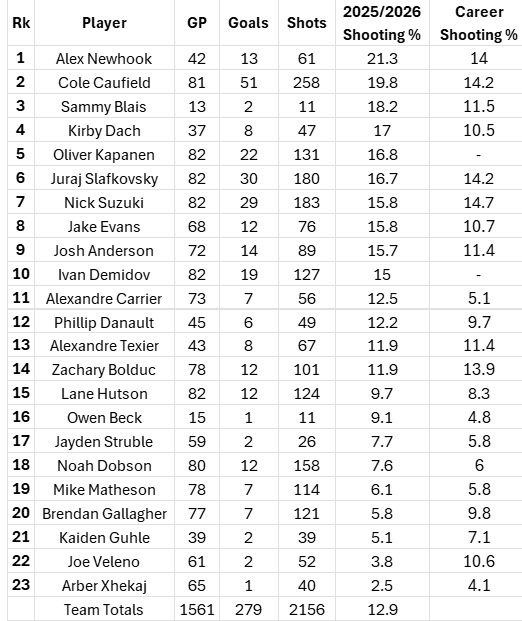

Certainly, as a skilled team, it makes sense that this version of the Habs would be able better than league average. However, when players such as Jake Evans, Josh Anderson, Phillip Danault, and Alexandre Carrier are well above league average, it does raise concerns that this past season was an aberration. These players are not known for their sharpshooting ability and there is a risk in the future that they revert back towards their career average (or below).
Overall, team performance was exceptional in 2025-2026 driven by major improvements in offensive performance driven by increased scoring from the defence, power play efficiency, and improved team shooting percentage. Defensively, the team made small improvements in goals against.
Asset Management
In terms of player movement, this past season was an extremely quiet one for Habs management with only a few transactions of significance.
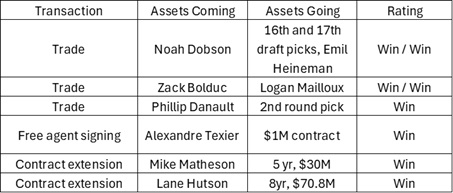

Noah Dobson: The acquisition of Dobson was a big change in approach for the management team. For the first time, Hughes sent away future assets and announced to the league that they are entering a win-now mode. Montreal clearly needed an upgrade on the right side and they weren’t willing to wait for either draft picks or prospects such as Logan Mailloux to develop. Unfortunately, giving up a promising middle-six winger in Emil Heineman was just part of the price to be paid. The Islanders already had an upgrade on Dobson available with the top pick in Matthew Schaefer, and were able to pick up valuable draft picks and Heineman, who had a very successful first season, scoring 22 goals and 31 points. This was a trade in which both teams are very happy.
Zach Bolduc: As a result of the Dobson trade, Hughes found himself with a surplus on defence and open spots on the wing. Giving up a promising young defenceman in Mailloux, he was able to acquire a promising young forward. Bolduc’s first season started off strong but ended up being more of a hit-and-miss, with him only scoring 12 goals and 30 points, which was a drop from his rookie season of 19 goals and 36 points. While Bolduc did bring much-needed physicality to the lineup, there were too often missed defensive assignments and poor execution on offensive zone plays. Bolduc spent time on all four lines, never really settling into a role.
Conversely, Mailloux’s season started poorly with him seeing limited ice time and being a defensive liability. However, the season ended strong with him playing much-improved defence and over 20 minutes per game while scoring five goals and 13 points in 67 games.
After one year, I think both teams are happy with the trade as they acquired assets in positions of need. But in the long run, I still think Mailloux is going to be a top-pairing defenceman and Montreal will regret this trade.
Phillip Danault: I will have to admit that going into the season, I was extremely frustrated that Habs management did not acquire a centre and entered the season with only Nick Suzuki and Jake Evans as proven centres. Who would centre the other two lines was a complete mystery and the team was one injury to Suzuki away from a miserable season. However, the acquisition of Danault for only a second-round pick was the best trade Hughes has ever made. Danault, who is an elite defensive centre, had an immediate impact on the team, solidifying the position at five-on-five and shorthanded. Danault worked in the playoffs to shut down opposing players, win key faceoffs in the dying minutes of the game, and helped propel the Habs into the third round of the playoffs.
Alexandre Texier: Playing only eight games early on, in November 2025, Montreal signed Texier as a free agent after he was released by St. Louis. Texier exceeded expectations in putting up eight goals and 20 points in 43 games while playing on virtually all four lines. His acquisition by Kent Hughes provided quality depth and versatility to the lineup for $1M prorated.
Other Key Moves:
Signing Lane Hutson to an eight-year contract extension worth $8.85M per season. What I like about this deal is that Hutson is already performing at this level, so Montreal isn’t gambling that Hutson will improve and eventually play up to this contract. He’s doing it already and as long as he doesn’t get a neck injury that prevents him from head-faking out opponents, this will be a good long-term contract for the team.
Signing Mike Matheson to a five-year contract extension of $6M per season. Matheson played his best hockey this past season and despite his age (32), there’s no reason to think that it won’t be a reasonable contract for the majority of the term. The only question is that with Hutson and Guhle already locked up on the left side for long-term sizable contracts, could Matheson have been better used as a tradeable asset for other more pressing needs?
Verdict: 9/10
Gorton and Hughes deserve a lot of credit for their performance this past year and from previous seasons. This isn’t to say they have made all the right moves or haven’t made mistakes, but the team they built just completed a 106-point season, finishing fifth overall. An impressive feat!
From the numbers, it is clear that team success was driven by offence and specifically by a top shooting percentage. Regression of this stat back to career averages for the players could see the team take a step back if no other improvements to team possession or defence are made.
The team was also relatively healthy with no injuries to key players, with the exception of Guhle. And in that position, Hughes had enough depth on the team to absorb the loss.
The trades Hughes made all worked out well for the team in 2025/2026. While it may be too early to say if Montreal won or lost those trades compared to their trading partner, each trade brought a player in a position that was needed.
I like the fact that Hughes didn’t panic when the team goalies were struggling with consistency early in the season. They used their depth at the NHL and AHL levels to give the players time to work through the issues. We’ve seen other teams (like Edmonton) make some panic moves that they no doubt regret.
There were two key moves that would have given Gorton and Hughes a perfect 10 out of 10 for the season. The first is being able to trade Patrik Laine. It was clearly obvious that the coaching staff didn’t want to play Laine. While it wouldn’t have been easy to move this contract, it would have been good for both Laine and the team to get an asset in return. Laine now walks for nothing in free agency.
The second move would have been to acquire a top-six centre. This is a clear need for the team and was one of the gaps that prevented them from winning the Cup this year. While I understand they are difficult to acquire, not giving the team all the assets they need to win is like playing shorthanded. This is something Hughes still needs to address.
Maybe these last two moves is asking too much, but to get a 10 out of 10 from me, you need to earn it!
Overall, this was a very good season for Habs Management with no major errors or mistakes. Looking back, I can’t imagine Gorton or Hughes would regret any of the moves they made in 2025/2026.