
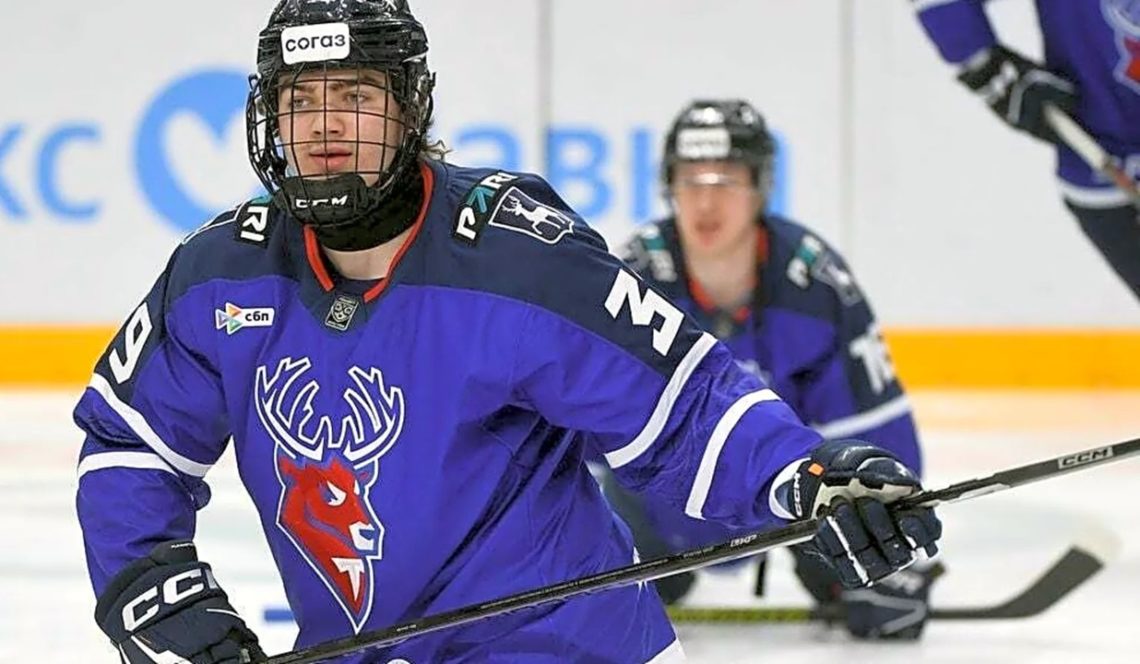
When the Canadiens selected Gleb Pugachyov 26th overall in last month’s draft, most Habs fans were introduced to him through the usual draft-night labels: big winger, Russian prospect, physical game, power-forward upside, blah, blah, blah …
But Russian-language coverage paints a more interesting picture.
You see, Pugachyov is not simply another large winger from the KHL/MHL pipeline. He is a Kazakhstan-born, Kaliningrad-raised, emotionally charged forward with a serious, almost Ovechkinesque, athletic family background, an early obsession with hockey, a developing reputation for physicality, and comparisons to Alexander Radulov that are not entirely accidental.
So …
Here are 20 things Habs fans should know about him from Russian sources and media.
1. He was born in Kazakhstan, not Russia.
Pugachyov was born in Almaty, Kazakhstan, on March 25, 2008. The Canadiens’ own draft profile lists him as an Almaty native, while Russian sources go deeper into how important Kazakhstan was to his family story. (NHL) He is not the first Habs prospect to come from Kazakhstan; the previous one was Alexander Perezhogin.
2. His family has deep roots in Almaty.
In Russian coverage, Pugachyov explained that his great-grandmother lived in Kazakhstan, his parents met there, and his father attended the same Kazakh school that Gleb later attended. (Спортс’’)
3. He started skating at three years old.
According to the Russian profile, Pugachyov first got on skates at age three after receiving skates as a New Year’s gift. From there, he spent long days skating outdoors in the yard. (Спортс’’)
4. He started organized hockey at five.
His parents put him into hockey at age five. His grandfather had played amateur hockey, and Pugachyov said the sport immediately appealed to him. (Спортс’’)
5. He was already obsessive about hockey as a child.
One of the best details from the Russian interview is that Pugachyov said he used to wake his father at four in the morning to get to early practices. He described his childhood mentality simply: there were no other options, only hockey. (Спортс’’)
6. He comes from a very athletic family.
His father was involved in weightlifting, his mother did track and field, and his younger sister plays volleyball while also attending music school. For a player now known for strength, size, and competitiveness, that family background was formative. (Спортс’’)
7. His move to Russia started through Kaliningrad.
Pugachyov’s father went to Kaliningrad for work and became interested in the Yantarnaya Zvezda hockey school. The family initially considered it as a short trial, but they ended up staying permanently. (Спортс’’)
8. Kaliningrad became a major part of his identity.
Pugachyov later said the level of hockey in the St. Petersburg championship, where Yantarnaya Zvezda played, was higher than what he had experienced in Kazakhstan. He also said he still has close friends in Kaliningrad. (Спортс’’)
9. His first Russian coach still matters to him.
Russian coverage notes that his first coach in Russia was Artem Nekerov (Now a skills coach in San Jose), who later worked in North America on skating and hockey skills. Pugachyov has named him as one of the important influences in his development. (Спортс’’)
10. His path included Vityaz before Torpedo
Before becoming a Torpedo/Chaika prospect, Pugachyov went through the Vityaz system. Russian sources present his path as Almaty to Kaliningrad, then into stronger Russian hockey regions and development structures. (Спортс’’)
11. He broke into the MHL in 2024-25.
Sports.ru notes that Pugachyov debuted in the MHL during the 2024-25 season with Chaika and picked up an assist in his first game against Sibirskie Snaipery. (Спортс’’)
12. His first MHL season came with discipline issues.
The Russian profile does not hide the rough edges. It notes that his first MHL season included a difficult stretch with penalties and a suspension. That fits the broader scouting picture: Pugachyov plays hard, but part of his development is learning where the line is. (Спортс’’)
13. He became a playoff leader for Chaika.
By the 2025 playoffs, Pugachyov had become one of Chaika’s key players, producing 11 points in 14 playoff games. (Спортс’’)
14. He took another step in 2025-26.
Sports.ru described the 2025-26 season as another step forward: he improved his MHL production, earned a Challenge Cup invitation, and made his KHL debut in January. (Спортс’’)
15. He played in three leagues in one season.
The Canadiens’ own “by the numbers” piece notes that Pugachyov played in the MHL, VHL, and KHL during the 2025-26 season. That matters because he was not simply dominating one junior level; he was being tested across the Russian ladder. (NHL)
16. His KHL arrival was delayed by appendicitis.
Russian coverage says Pugachyov had planned to debut in the KHL earlier, but he missed training camp because of an appendicitis flare-up and surgery. He then had to recover and rebuild his conditioning. (Спортс’’)
17. His first KHL goal came at 17.
Pugachyov scored his first KHL goal with Torpedo Nizhny Novgorod on January 14, 2026, at just 17 years old. Montreal’s official profile also notes the milestone. (NHL)
18. His first KHL goal was not empty production.
Against Lokomotiv, Pugachyov scored his first KHL goal and added an assist. Sports.ru notes that the goal was a game-winner and that he put four shots on net in just 8:51 of ice time. (Спортс’’)
19. He immediately followed it with another game-winner.
In his next game against Spartak, Pugachyov scored the only goal in a 1-0 Torpedo win. That is where the Russian hype started to build: a big, emotional teenager arriving in the KHL and scoring decisive goals right away. (Спортс’’)
20. The Alexander Radulov comparison is real — but should be handled carefully.
Russian media has leaned into the “new Radulov” idea because of Pugachyov’s size, emotional style, physicality, and early KHL impact. Pugachyov himself has said Radulov is one of his favourite players, praising his size, hard character, emotion, physical play, decision-making, and passing ability. (khl.ru)
That does not mean he is Alexander Radulov. It means the model he admires is clear: a big, emotional, skilled winger who plays with force and personality.
Bonus: He gave Montreal a very memorable interview answer.
In a Russian report after the draft, Pugachyov said Montreal asked him what he would do if he threw a hard hit against Washington and Tom Wilson came after him. His answer: he would be ready to fight, and “nothing would be left” of Wilson. (Спортс’’)
The Canadiens did not hide their enthusiasm. Kent Hughes said Pugachyov has size, plays a physical game, has good hockey sense, has versatility, and already has an identity. Martin Lapointe went even further, calling him a “unicorn” because of the details in his game at his age: blocking shots, backchecking, finishing checks, and bringing pucks to the net. (NHL)
Montreal also clearly valued the package enough to trade up from 28th to 26th, sending the 28th pick and a 2027 third-rounder to Vegas to get him. (NHL)
Final thought.
For Habs fans, the appeal is obvious.
Pugachyov is not being sold as a safe, quiet, polished prospect. He is being sold as something much more volatile and much more fun: a big winger with skill, bite, confidence, and an identity Montreal clearly believes is rare.