
The Tampa Bay Lightning vs Montreal Canadiens series will probably be one of the most exciting series in the first round. Don’t take my word for it; it’s been repeatedly mentioned by many reporters throughout the NHL. An up-and-coming, exciting, talented team matching up against an experienced and tested powerhouse with a very long and successful pedigree.
The young talent versus experience goes beyond the ice surface as Martin St-Louis will face his ex-coach, Jon Cooper, throughout this series in an attempt to use their respective rosters to counter the opposing strategies. St-Louis has often said that he has looked up to Tampa Bay as the model to follow for the Habs. This series will be the ideal test to measure how close the Habs are to their objective.
Although both teams met in the 2021 Stanley Cup Final, it would be futile to use this to evaluate the current faceoff. Both teams, particularly Montreal, are vastly different and play a different brand of hockey. Montreal’s lineup and coaching staff only has a few members who were there in 2021, and the Lightning have considerably changed their culture to contend with their recent rivals, the Florida Panthers.
There are as many ways of winning a Cup as there are playoff series in the NHL. That said, there are a few key factors that seem to improve your chances of being successful. Most teams that have been successful in the playoffs generally have exceptional goaltending. Sometimes it’s a known elite goaltender that lives up to his reputation and sometimes it’s an average, or even below-average, goaltender who elevates his game beyond expectations.
The second important factor is the contribution of the star players. The overused phrase, “your stars have to be your best players to win”, is boring to hear, but it remains true. Thirdly, most successful playoff teams have a few unexpected heroes who elevate their game and provide secondary offence or a shut-down defence that forces the opponent to change strategy and introduces doubt in their game.
Goaltending
The Andrei Vasilevskiy – Jakub Dobes matchup typifies the entire series. A goaltender with a trophy chest filled with Stanley Cups, Vezina, and Conn Smythe trophies, matching up against arguably the best rookie goaltender in the league this year.
Vasilevskiy has been consistent this year with a 39-15-4 record and a 0.912 save percentage. He is a favourite for the Vezina this year and has been the main reason for the team’s success while injuries were plaguing the lineup. Dobes had an up-and-down season. Although he struggled earlier in the year, he was able to muster up wins regardless. The second half of the season was much better as he finished with a 29-10-4 record and a 0.901 save percentage.
Based on those numbers alone, Tampa Bay has a clear advantage here. But looking deeper at the most recent numbers may point to which goaltender has a better chance of going on a hot stretch of games. Looking at the last 20 games of both goalies, Dobes is by far the more effective goaltender, finishing on top of the league with 18.9 Saves Above Expected, per MoneyPuck, while Vasilevskiy sits 31st at 2.0 Saves Above Expected.
Vasilevskiy has shown in 2019-2020, 2020-2021, and 2021-2022 that he can definitely elevate his game in the playoffs with save percentages north of 0.920. However, in the last three years, he has significantly underperformed in the playoffs with save percentages below 0.900 despite excellent regular season performances.
Like the rest of the team’s core, Vasilevskiy is getting older at 31 years old, and he has been tested much more than Dobes in this difficult schedule. His experience and pedigree will be an important advantage, especially during the critical first two games in Tampa Bay. Dobes’ confidence is high but his lack of experience also makes him much more fragile. Contrary to last year’s playoffs, Dobes is coming in as the clear starter. The possibility that he remains hot and frustrating for Tampa Bay’s top players as we saw in the last two games between these teams this season, would not be as surprising as one would think based on the underlying numbers.
Core Players
Looking at each team’s top point-getters, they are surprisingly similar. Both have a centre, two wingers, and a top defender, both groups dominate the ice with high On-Ice Goal%, and both have an elite playmaker with 100+ points.
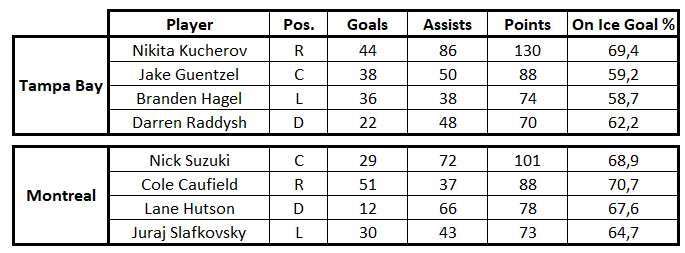
Some of the subtle differences are worth noting, though. Tampa’s playmaker (Kucherov) is also the top goalscorer and 29 points above Suzuki. Montreal has a higher average On-Ice Goal% between the four members compared to Tampa Bay (68% vs 62%).
These numbers alone will likely affect both teams’ strategies. For Tampa Bay, shutting down Montreal’s first line will be an important key to their success. For Montreal, shutting down Kucherov alone will affect Tampa Bay more than Tampa Bay trying to shut down a single Montreal player.
Clearly, the Toronto Maple Leafs in 2022-2023 and the Florida Panthers the last two years focused on removing Kucherov as much as possible from his game over the previous three playoffs, limiting him to one goal in 16 playoff games.
Tampa Bay’s advantage is that the Habs’ top three forwards are on the same line while Kucherov plays with Brayden Point and Gage Goncalves, while Hagel and Guentzel play with Anthony Cirelli. It will be interesting to see if Martin St-Louis will put Slafkovsky with Ivan Demidov and Alex Newhook, especially when they play in Tampa Bay and don’t have the last line change.
Wild Cards
This is where the difference between the Habs and the Lightning is the most apparent. Again, the main reason is experience. Tampa Bay’s wild cards are not that surprising as they have already shown up in previous playoffs. For Montreal, it could come from anyone in the bottom six and no one at the same time. It’s a complete mystery. The advantage of the unknown though, is that Jon Cooper can hardly adjust or plan accordingly before the series starts.
The four main candidates for Tampa Bay are Nick Paul, Yanni Gourde, Zemgus Girgensons, and Corey Perry. Paul was an important contributor when they acquired him from Ottawa in 2022, with nine points in 23 games in the subsequent playoffs. Although he has had three good regular seasons for Tampa Bay after that run, his playoff performances have significantly cooled off. This season’s 15 points in 51 games is well below his better years and it would be surprising to see him become a game-changer versus the Habs. At 31 years old, his best years are clearly behind him.
Girgensons and Gourde have been an excellent pair for them, often used as an energy line. When playing with Pontus Holmberg, they are the most consistently used line for Tampa Bay, earning 56.2% of xGoals, also getting a 1.97 xGoals per 60 minutes. During the last two games versus the Habs, this line was often used to put pressure on Hutson.
Perry is a veteran who knows how to play in the playoffs. He will undoubtedly stir chaos against Montreal’s best players and it will be interesting to see how he affects their play. He was not very successful in the last two games but over an entire playoff series, this may produce wear and tear on the Habs both physically and mentally.
The Canadiens don’t have a proven bottom six able to contribute to the team’s success like Tampa Bay has. That said, they do have players who fit the required qualities to do so. The most obvious candidates to initiate and maintain chaos on Tampa Bay’s core, particularly Kucherov, are Josh Anderson, Kirby Dach, and Zachary Bolduc. All three are fast, big physical forwards with some meanness in their game. Anderson has shown that over the years (and on Kucherov during their last matchup) but the other two remain only potential candidates.
The problem with Montreal’s bottom six is that it has changed regularly over the entire season due to injuries. The advanced stats on these players together are quite limited. The Bolduc-Evans-Anderson combination has earned 56.7% of xGoals but they have only played 57 minutes together, compared to more than 600 minutes for the Girgensons-Gourde-Holmberg line for Tampa Bay.
Many other factors that are not covered in this comparison could also affect the outcome of this series. Injuries to key players could definitely change the dynamic and that is completely unpredictable. In addition, a comparison between the two teams’ defensive pairings hasn’t been discussed. In light of Noah Dobson’s injury, this could be an important factor. Also a factor to consider is that the Habs enter the playoffs with the best record in the NHL since the trade deadline, with a 16-6-1 record, while Tampa Bay finished 11th at 12-8-2 over the same period.
The underlying theme when comparing these two teams is that Tampa Bay is road-tested and experienced, but also has an aging core. The Habs are still in learning mode and their playoff ‘brand’ remains to be developed. Following an impressive season, if they can compete better than the series against the Washington Capitals last year, it will be a complete success towards becoming a perennial Cup contender.