
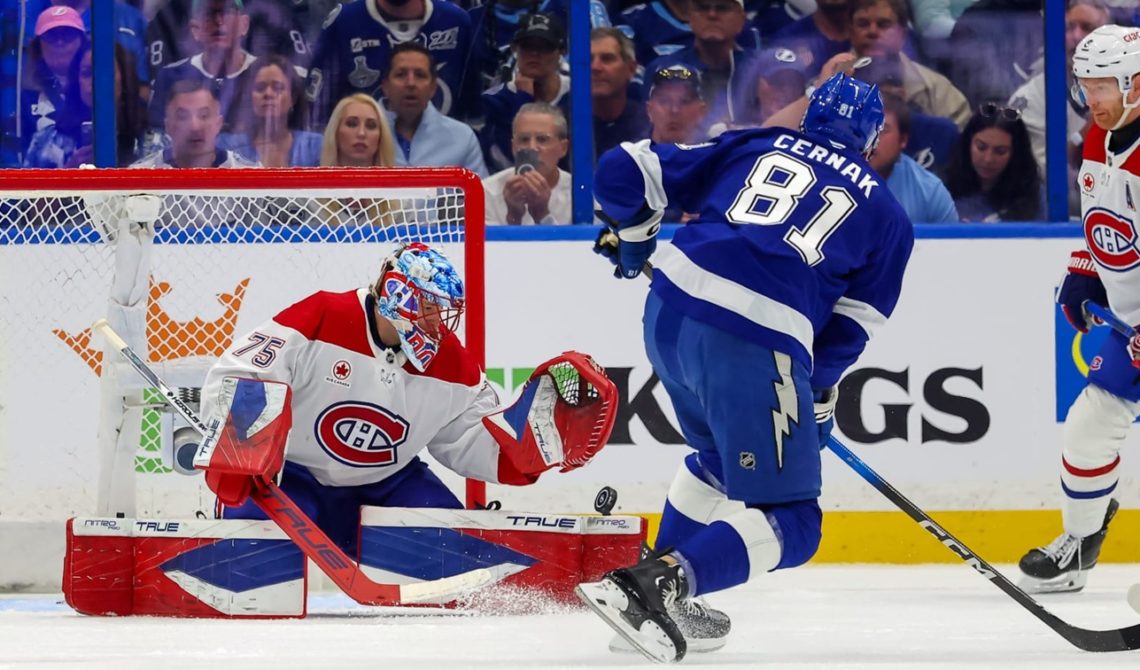
Last night marked a decisive shift in tone in this opening-round series between the Montreal Canadiens and the Tampa Bay Lightning, one Habs fans haven’t felt since Milan Lucic ran amok on the team’s key players.
What began as a promising matchup following an electrifying Game 1 quickly evolved into something far more unforgiving. Montreal’s 3–2 overtime loss was not simply a setback on the scoreboard, but a revealing moment in the psychological and physical dynamics of the series.
Game 1 had offered a glimpse of what this young Canadiens team could become. Juraj Slafkovsky’s overtime hat trick elevated both his stature and the belief surrounding Montreal’s top line despite it being stuck in Cirelli quicksand.
Despite being largely contained at even strength, the Canadiens capitalized on their opportunities and imposed enough pressure to earn a dramatic victory. It was, in many ways, an ideal start.
Game 2, however, belonged to Tampa Bay in every intangible sense. As head coach Jon Cooper suggested following the game, his team is comfortable embracing a more ‘bad guy’ role. That identity was evident throughout the night. The Lightning dictated the physical pace, disrupted Montreal’s rhythm, and gradually shifted the emotional balance of the contest. By the time J.J. Moser scored the overtime winner, the outcome felt less like a surprise than a culmination.
Well … to me at least.
The most telling sequences were not limited to scoring chances or territorial play, but rather moments of physical and emotional assertion. Brandon Hagel’s repeated confrontations, including a sequence in which he dropped Slafkovsky, underscored a broader issue for Montreal. The Canadiens, despite their size and potential, struggled to respond to Tampa’s imposed viscerality. Such moments carry weight beyond the immediate play; they shape perception, confidence, and ultimately the trajectory of a series.
Montreal’s difficulty was compounded by its relative inexperience. Tampa Bay’s core, shaped by multiple deep playoff runs and two Stanley Cup championships, demonstrated a composure and awareness that the Canadiens are still developing. The Lightning maintained control not only of the puck in overtime, outshooting Montreal dominantly, but also of the emotional tempo throughout the latter stages of the game.
There is also a strategic question to be addressed. Under Martin St. Louis, the Canadiens have embraced structure and discipline, traits that have fuelled their rapid progression. Yet Game 2 raised the possibility that an overly restrained approach may limit their ability to counter a team willing to operate on the edge. Players such as Arber Xhekaj and Josh Anderson have shown an ability to balance physicality with control, but the collective response from Montreal lacked the assertiveness required to shift momentum.
As the series moves to Montreal tied at one game apiece, the Canadiens face a critical inflection point. The margin between competitive resilience and psychological erosion is thin, particularly against an opponent adept at exploiting both. If Montreal is to regain control, it will require not only tactical adjustments, but a willingness to engage on the same emotional and physical terms—without sacrificing discipline.
Game 2 will not define the series on its own. However, the manner in which it unfolded has introduced a narrative that the Canadiens can ill afford to let settle.