
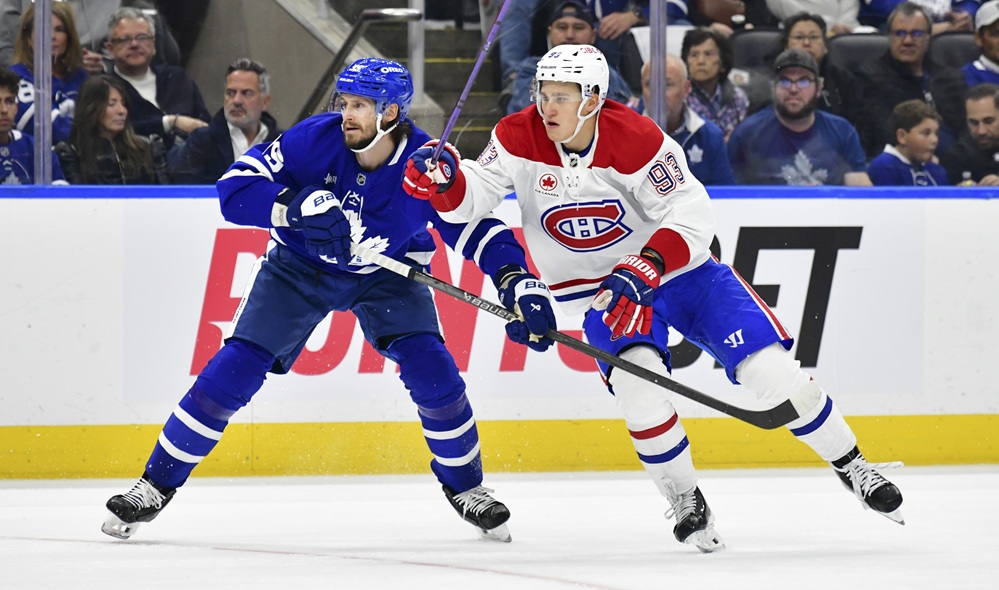
Imagine being in a parallel universe where the Habs selected in the second round of the 2022 draft (62nd overall) a young man named Quinn Hughes, and two years later selected a young Russian player named Pavel Datsyuk fifth overall. The Habs already have a great first line early in the 2025-2026 season, among the top five lines in the league, and the phenom Quinn Hughes just starting his second season with the Habs. That same year, the new rookie from Russia makes his debut with the team. In that parallel universe, the Habs have a young core group that is locked in long-term and just added Datsyuk to the lineup.
Having the Nick Suzuki line along with young Quinn Hughes and Pavel Datsyuk joining the group is quite an enviable roster. It’s easy to see where I’m going with this, but the stats suggest we may be in the early years of this being the case.
In this comparison, I have used players who seem to have the same style of game. It’s always difficult, or outright wrong to compare a rookie to any established player. Nonetheless, we all do it consistently. Is Jonathan Toews the next Steve Yzerman? Is Sidney Crosby the next Mario Lemieux? Is Nathan MacKinnon the next Crosby? Is Auston Matthews the next Alex Ovechkin? All these comparisons seem quite off in retrospect but they were all mentioned at some point. The reality is that each player has his own story, career, and legacy once their career ends. And that’s the beauty of watching hockey players develop over the years becoming the best version of themselves. Some turn out to be much less than expected and others much better. More often than not, young players become a close comparison to what was expected.
Lane Hutson and Ivan Demidov are the two new upcoming stars of the Habs lineup. They are both very talented, have a unique style of play, and could impact the Canadiens’ rich history in the years to come. Over the last few months, they have become close friends. They are roommates on road trips, always last on the ice during practice, and only have one subject of interest, hockey.
Hutson has been compared to Quinn Hughes a lot in the last two years. Both are smaller defencemen with outstanding skating abilities and an offensive edge over their opponent. They defend using their hockey IQ and their stick more than their body. As for Demidov, a few names have been thrown out there, including Nikita Kucherov and Kirill Kaprizov, but Demidov’s pass-first approach to the game and ability to deceive the opposing defence reminds me of Pavel Datsyuk. They are by no means perfect twins, but as mentioned, no two players are the same. The similarities are striking nonetheless.
If we look back at Quinn Hughes’ career so far, the numbers over the first few years show a striking resemblance to Lane Hutson so far.
All stats are as of November 2nd.
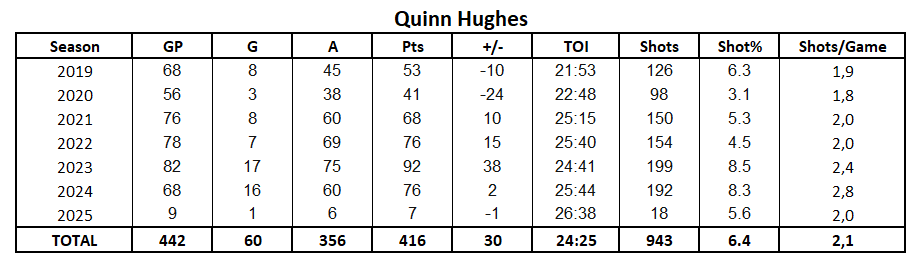

Both Hutson and Hughes are pass-first in their offensive threat. Lane’s first season of six goals and 60 assists for 66 points (0.81 pts/game) is in line with Hughes’ 0.78 pts/game. That said, Hutson’s shot per game of 1.2 is a little lower than Hughes, with a similar shot %, explaining the difference in goals between the two. If we use the following years of Hughes’ career so far as an indication of Hutson’s future production, we can see that both his shots per game and shot % should improve. In fact, this is very common for most elite prospects. Typically, younger players shoot more as they gain experience and their precision increases. In general, it takes three to five years to reach peak efficiency. It is therefore reasonable to expect Lane Hutson to have regular point-per-game seasons including about 20 goals per season.
It is obviously more difficult to get an idea of what to expect for Demidov. What we do have is 13 games, including two last year. What seems obvious so far is his edge work, how he hides his plays, his high hockey IQ, and ability to beat defenders one-on-one in close spaces. Those were the main attributes of Datsyuk as well.
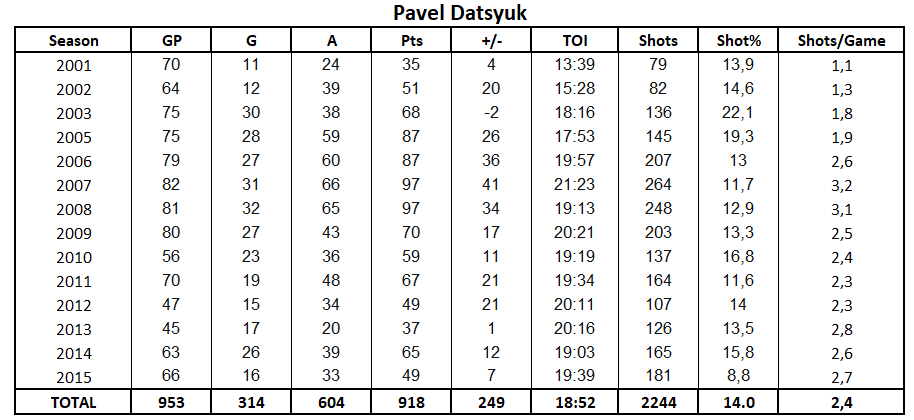

Datsyuk was also a pass-first forward, with a career high of 32 goals only. As we’ve seen with Hughes, Datsyuk’s shot-per-game ratio started low at 1.1 and peaked at 3.2 during his two best seasons, each with 97 points. Another very impressive statistic is his +/- of 249 with only a single season in the negative. That is ranked 47th in NHL history.
If we compare these four players over their respective first 14 games for Demidov and Datsyuk, and first 96 games for Hutson and Hughes, we can observe that both Hutson and Demidov compare well with Hughes and Datsyuk.


These comparisons are based on very little data, particularly for Demidov. What they do show very clearly, though, is that we shouldn’t worry too much about both players’ lack of shots. This is a completely normal progression for virtually all pass-first type rookies. In their rookie season, Cale Makar’s shot/game average was 2.1, Connor McDavid was 2.3, Leon Draisaitl was 1.3, and Mikko Rantanen was 1.8. All of these players now average over three shots/game.
Based on many high-profile prospects in the past, both Hutson and Demidov could potentially be elite superstars in the NHL in two to four years, joining the Suzuki line as one of the most dangerous core groups in the NHL.