
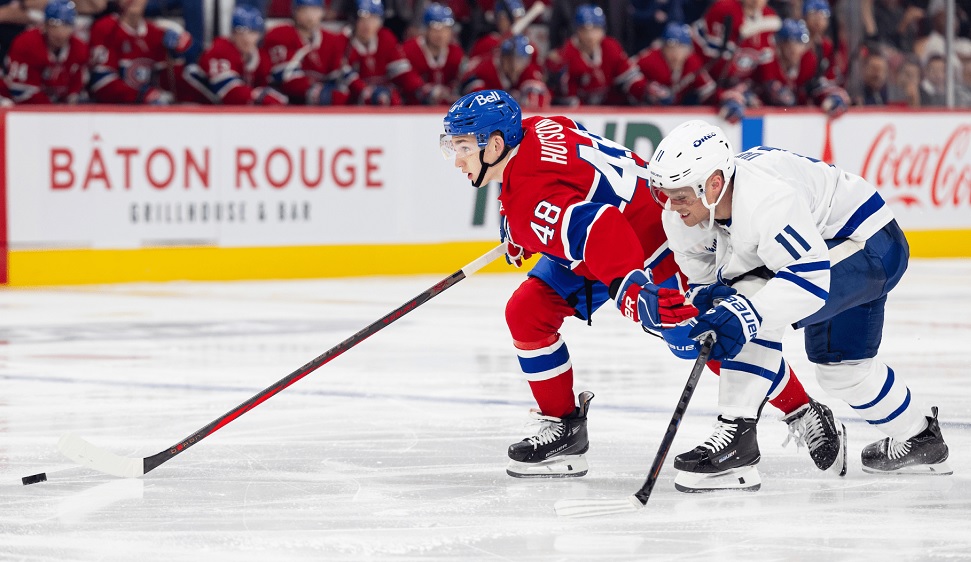
The Habs took care of a big piece of business earlier this week when they signed Lane Hutson to an eight-year, $70.8 million extension. Our writers offer up their thoughts on the signing.
Terry Costaris: There is always an element of risk in every long-term contract. The elephant in the room is that Hutson is not the biggest player on the Montreal Canadiens. Some monster-sized player may end his career on a single play.
But what do you do? Ignore his enormous skill set? That’s just not an option.
If Hutson was two inches taller, the entire fanbase would be more certain that he’d be able to withstand the rough and tumble of NHL hockey. But what about big men such as Kirby Dach? Maybe size is not the be-all and end-all here. Bad luck is not something that you can bet on. Whatever will be will be.
The numbers and eye test tell us that Lane Hutson is an extraordinary defenceman. As a result, his market value dictates that, at the very least, he receives high compensation.
The truth of the matter is that Hutson left some money on the table here. Money that will help Kent Hughes and Jeff Gorton make other key transactions when the time is right. I can’t imagine any NHL team, if given the opportunity to land Lane Hutson with this very well-crafted contract, would pass on such an opportunity.
A huge chunk of Hutson’s contract is in the form of early bonuses. So, if he manages to get “Webered” or “Priced” (I just created two new TM verbs here) in terms of suffering a debilitating injury, his contract could likewise be moved to a team trying to make the cap minimum.
This aspect of the deal should mitigate some of the fears that Habs fans have about a defender who is two inches shorter than what is considered to be the minimum height requirement of an NHL defender.
There are basically two scenarios in terms of how the Lane Hutson deal turns out. Things can go real North and his contract would thus be deemed a steal. Likewise, things could go real South due to injuries and his contract could be refurbished into something that could be very attractive for a rebuilding club trying to make the cap floor.
Either way, then, there’s not much for Montreal Canadiens fans to fret about. It’s all good.
Brian Davis: Relief was my first reaction when the contract was signed. The media frenzy, the endless speculation, and the visible toll it was taking on Hutson on the ice made it a pressing issue. Getting it sorted before the home opener casts a positive light on both the player and the occasion. When number 48 was announced, the ovation was electric.
As for the deal itself, it’s a masterclass in team building from the Hughes-Gorton axis. It speaks volumes about their vision and the players’ commitment to building something special. Locking in the top line and top three defencemen long-term for under $48 million—especially with a rising cap and a strong prospect pipeline—gives the club flexibility and a clear path forward. It also sets a powerful precedent: perform consistently and you’ll be rewarded, but staying part of this team means embracing the collective ethos to become better. I’ve always believed a cohesive unit will outplay a group of individuals, no matter how talented.
It’s no surprise, then, that Kent Hughes and Jeff Gorton have been signed for five more years. It’s both a well-earned reward and a clear signal of ownership’s full confidence in their leadership. I’d wager there are a few NHL franchises quietly lamenting this news—Hughes and Gorton would be dream hires for many facing the similar uphill battles the Habs faced only a few short years ago.
Brian La Rose: With the circumstances surrounding the Noah Dobson contract (only one RFA year instead of five) and Dobson’s success to this point in his career, it was pretty clear that the Habs were going to use that as an internal ceiling in negotiations. And if Hutson’s camp wanted more, he’d have to prove it with an even better showing this season. Avoiding that scenario is certainly ideal.
With the above in mind, this contract comes in pretty close to where I thought it’d land. If they were offering deferred salary while they still could, that was done to keep the AAV below $9M and in the end, pushing more signing bonus money to the front of the deal was enough to push this across the finish line. If he plays at the level he did last season, then this should age just fine for the Habs.
Even with deferred money off the table, two elements to this contract were time-sensitive to a point. Eight-year deals are about to become a thing of the past as are contracts with this much signing bonus money as there’s a stricter cap on signing bonus money coming next summer as well. That made an in-season deal the better way to go. Now, the focus for those two pieces will shift to Ivan Demidov as they’ll have a ten-week window starting in July to do a max-term extension with the ability to pad the contract with more signing bonus money. That’s the next big contract to keep an eye on.
Kevin Leveille: There it is. The majority of the core of the Habs are signed through 2030, mostly all of them on deals that keep the team financially competitive to add important pieces moving forward. Hutson’s contract announcement on Monday shocked many, but remember that the Habs are mostly buying his RFA years, not his UFA ones. Still, this deal is without a doubt a sweetheart one for them as the team was able to convince the player to take less than market value to avoid the distraction and open the window for the team to compete for 25. For Hutson, it’s financial security, a boatload of money, and making himself that much more loved by Habs faithful everywhere.
Despite all of this, there is little doubt that many of his advisors were likely of the opinion that he should have waited to allow the market to set itself to the new parameters of the cap thus allowing him to ask far more than the $8.85M he ended up getting. Should last year’s trajectory remain the norm for Hutson’s tenure in Montreal, it is without a doubt one of the contracts that will be one of the NHL’s biggest bargains by the time Hutson finds himself back at the negotiating table. A huge win for the core and competitiveness of the Habs moving forward.
Peter Longo: Overall, I like the contract. Unlike some of the other contracts that Hughes has signed, this one is reasonable because Hutson has demonstrated he can perform at that level. Historically, Hughes has run into problems paying players (who have no negotiating power) excessive contracts based on potential future performance. This, of course, has backfired and led to cap overages in the last few years when players struggle (such as Dach and Newhook). It remains to be seen if Slafkovsky’s contract will turn out similarly.
But Hutson is already a play driver for the team and was one of the main reasons the team made the playoffs last season. And unless Hutson gets a neck injury and is unable to head fake opponents (haha), his style of play is unlikely to fade over the years of the deal.
Hutson has zero negotiating power in this deal so the team could have played hardball and forced him to sign for much less, but Hughes smartly avoided this route for a key player (unlike his predecessor Bergevin) and both sides reached a reasonable deal.
Richard Roy: It appears to be unanimous in the hockey media across the country that the Hutson contract is a steal for the Montreal Canadiens’ management. Many bring recent comparables such as Luke Hughes (9.4% of team cap) and Jackson LaCombe (8.65% of team cap). Considering additional production and awards to Hutson, most were expecting north of $10M for Hutson. With his new $8.85M deal, Hutson will sit at 8.51% of the team cap next year.
In post-announcement interviews, Hutson spoke about wanting to be part of the core group in Montreal and win a Stanley Cup. The establishment of an internal cap in Montreal, first initiated with Suzuki’s contract and immediately followed by Caufield, Slafkovsky, Guhle, Evans, and even Dobson, added some pressure to the Hutson side of the negotiations to do the same. In addition, Kent Hughes had all the cards. Hutson would have been an RFA with no possibility of an offer sheet next summer and even further away from arbitration eligibility.
Kent Hughes also stated that the original thought in the summer was to agree with Hutson before the beginning of the season. Both Hughes and Martin St-Louis said that they worried that the distractions from the media regarding the deal could affect Lane’s (and the team’s) concentration and focus. When asked if it had caused some distractions to him, Lane Hutson admitted that it had.
Numbers don’t lie and support this concern. When comparing the first three games of last year with the first three of this year, Hutson isn’t playing as well. He is by no means “bad”, but he’s not playing at the level we are used to from him. Hutson already had four helpers last year after three games compared to one this year. He also had three takeaways and three giveaways (one in the defensive zone). This year, Hutson has no takeaways and five giveaways (five in the defensive zone).
With Lane being the main anchor on the first power play unit, it is no surprise that it has suffered so far this year. Now that the contract rumours are out of the headlines, the entire team can focus on the season and we can expect the power play to contribute to the team’s success as it was in the second half of last year.
Kent Hughes now needs to focus on the next big young gun, Zachary Bolduc. Undoubtedly, Hughes will want to see a larger sample size before negotiating with Bolduc, but that may end up costing him much more at the rate that Bolduc is producing.
Dave Woodward: This signing fits in nicely with Hughes’ strategy to build a team that will contend for many years. In isolation, Hutson’s contract (8 years and $8.85M AAV) is team-friendly when one considers the recent signings of Hughes and LaCombe. Dobson’s contract ($9.5M AAV for eight years) is not really a comparable as he was acquired on the open market and at 25, was soon to become a UFA. With a rising cap, unless he becomes mired in a sophomore slump, Hutson’s market value is unlikely to decline.
Why did Hutson accept it? The deal is front-loaded and includes large lump sum signing bonuses earlier in the deal’s term. For Hutson, that makes the number that much more attractive and, from the Habs’ perspective, the deal will be easier to move later in the term before the ten-team no-trade list kicks in during the last handful of years in the term. All that said, based on interviews after the signing, Hutson accepted a team-friendly deal because he wanted to be part of what they are building. For the first time in many years, at least some NHLers want to play in Montreal. The Canadiens are developing a team and a winning culture that players want to be part of.
With Hutson’s upside and the salary increases that are happening now and are projected with the salary cap’s projected rise, this writer views the contract as a team-friendly signing in isolation. Unless Hutson’s performance craters, this contract should age as well as the Suzuki deal.
The contract looks even better when viewed as part of Hughes’ overall strategy. The Canadiens now have Suzuki, Caufield, Guhle, and Hutson locked up long-term with team-friendly contracts. It remains to be seen whether the Dobson and Slafkovsky deals are team-friendly but they are both core pieces that are signed long term. These deals represent the foundation of a team that should be competitive for many years, especially when some of their other younger players (Demidov, Kapanen, Hage, and perhaps Reinbacher, to name but a few) are signed long term. The future is bright for the Montreal Canadiens.